Why You Overeat: The “Saving the Best for Last” Habit That’s Fueling Food Guilt
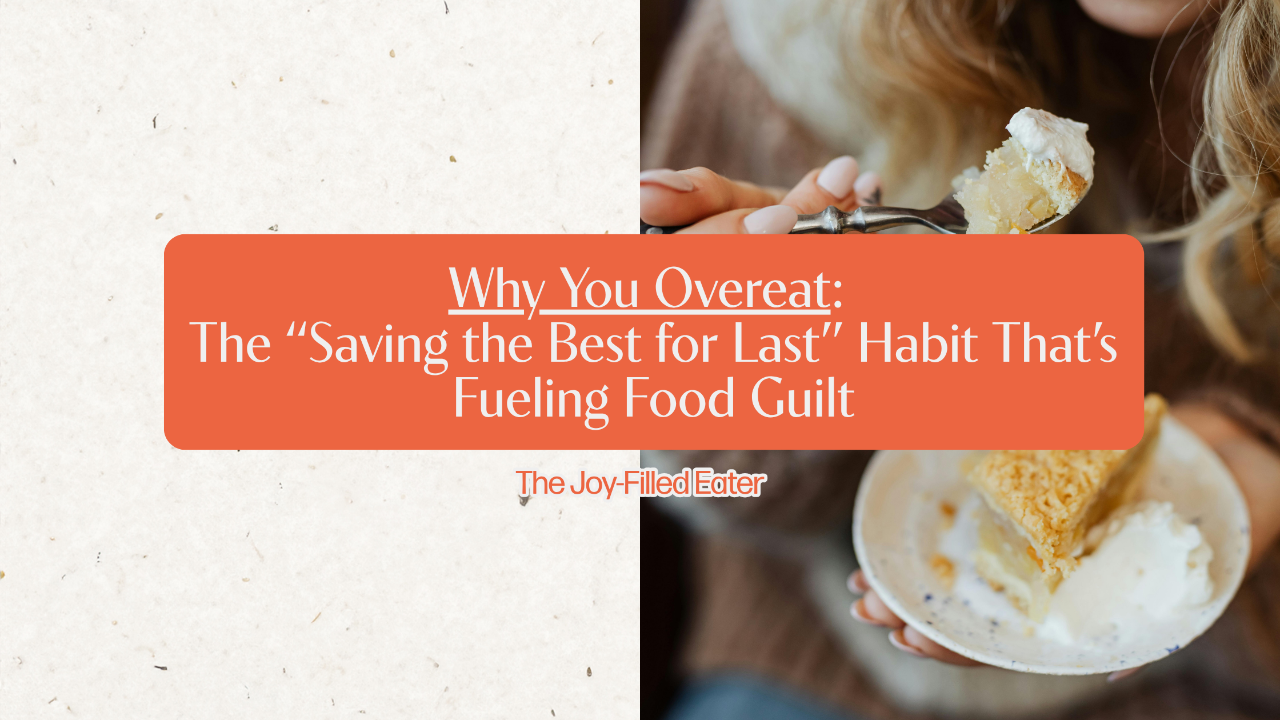
Ever sit down with your plate of food and immediately think, “Okay, I’m saving the best bite for last”?
Maybe it’s the cornbread.
Maybe it’s the dessert.
Maybe it’s that one casserole your family only makes on Sundays and holidays and we all act like it’s a national treasure.
It feels harmless. Even…wise? Like you’re being intentional. Disciplined. Responsible, even.
But what if that one tiny habit is quietly shaping your relationship with food in ways you never intended?
Not dramatically. Not overnight.
But slowly… subtly… and consistently reinforcing food guilt, food obsession, and that nagging feeling that you’re either “doing it right” or “messing it all up.”
Let’s talk about it.
The “Save the Best Bite for Last” Habit Feels Harmless… Until It Isn’t
This is one of those food rules that doesn’t sound like a rule.
It’s more like a tradition. A personality trait. A “this is just how I eat” kind of thing.
We do it with:
- The last bite of dessert
- The favorite side dish
- The “one thing on the plate I’m actually excited about”
Even kids do it. Husbands do it. Families joke about it.
But here’s where things get interesting.
When you consistently save the “best” food for last, your brain quietly starts assigning value levels to your plate:
- This food = exciting, rewarding, worth waiting for
- That food = filler, just something to get through
And without realizing it, you’ve just created a food hierarchy.
And food hierarchies always come with emotional consequences.
What’s Actually Happening in Your Brain When You Save the Best Bite
Let’s use a little analogy here.
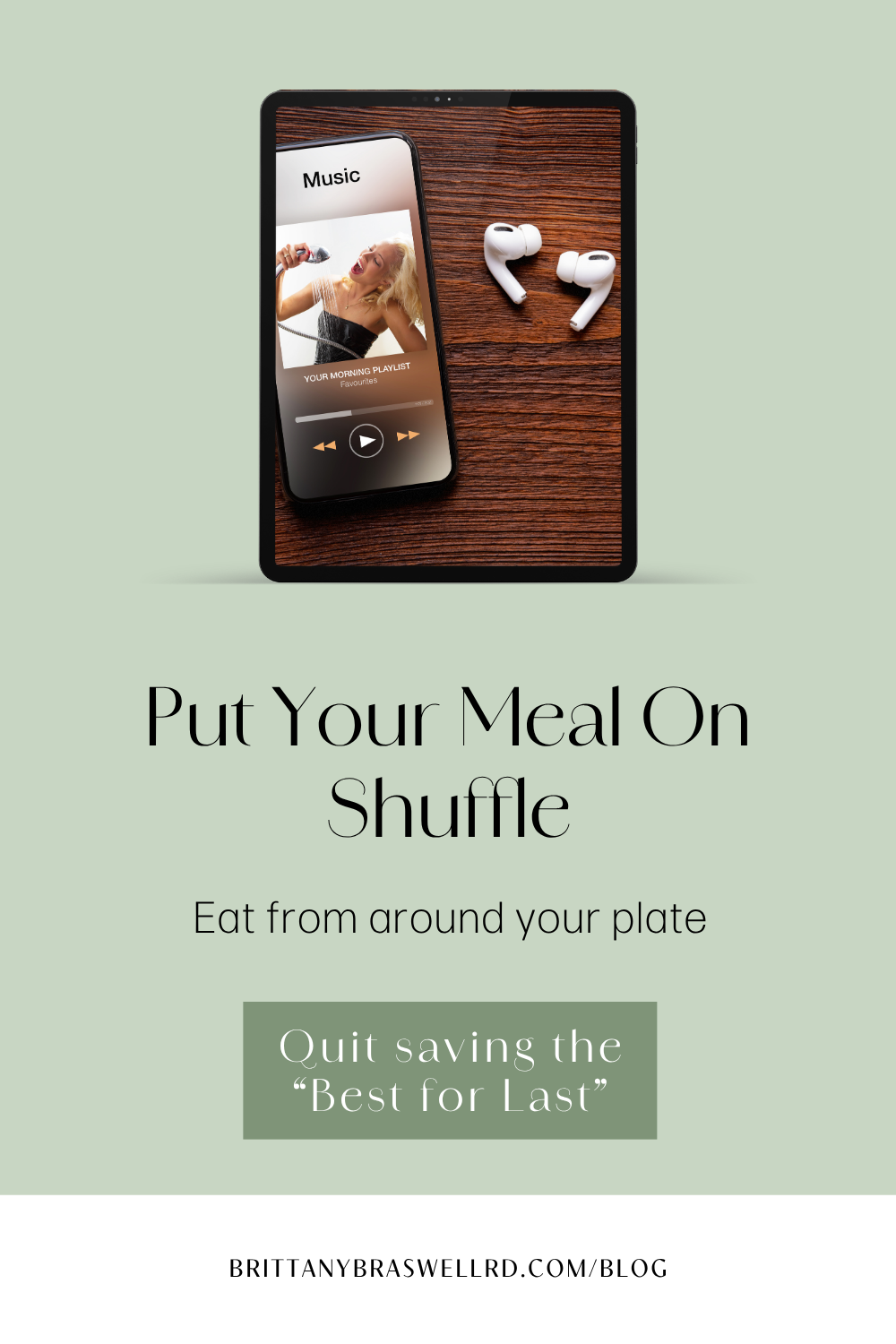
Think about your favorite music album or playlist.
You know that one song—the one that hits just right. The one you would absolutely replay on repeat if you could.
Now imagine listening to the entire album like this:
- Skipping through most songs
- Half-listening to the “okay” tracks
- Waiting impatiently for your song
What happens?
The whole experience becomes about getting to the end.
And when you finally get to that one song? It’s not even as satisfying anymore because you rushed through everything that led up to it.
Food works the same way.
When you rush through your meal to get to the “best bite,” a few things happen:
1. You disconnect from your hunger and fullness cues
Your body is constantly giving you signals:
- “I’m getting full”
- “I’m satisfied”
- “I’m past comfortable fullness”
But when your brain is laser-focused on the “reward bite,” those signals get pushed to the background.
So instead of noticing fullness, you’re noticing anticipation.
And that combination? Often leads to overeating without even realizing it.
2. You miss satisfaction in the whole meal
Satisfaction is a key part of feeling full.
Not just physically full—but emotionally content with your meal.
When you ignore or rush through parts of your plate just to get to the “best,” you miss out on:
- Texture
- Flavor
- Temperature differences
- The actual enjoyment of eating
Ironically, you might actually enjoy more of your food if you slowed down long enough to notice it.
How Food Hierarchy Quietly Fuels Food Guilt and Obsession
Here’s where this gets really important.
Because this isn’t just about eating habits.
It’s about meaning.
When you label foods as:
- “Best”
- “Good”
- “Just okay”
- “Filler”
You’re not just organizing your plate.
You’re creating emotional weight around your food choices.
And over time, this leads to a few sneaky patterns:
Scarcity mindset creeps in
When something becomes “the best,” your brain automatically starts thinking:
“I better get more of that while I can.”
Even if there’s plenty of food.
Even if you’re fully fed.
Scarcity creates urgency. Every time.
Food starts feeling more powerful than it actually is
That “best bite” becomes elevated in your mind.
And suddenly:
- You’re thinking about it while eating other foods
- You’re rushing through the meal
- You’re less present with everything else
And here’s the kicker…
The more rare and special you make that food in your mind, the more your brain wants it.
Not because you’re “out of control.”
But because your brain is responding exactly how it was designed to respond to scarcity and reward.
Food guilt grows in the background
Because now the narrative becomes:
- “I should’ve waited”
- “I ate that too fast”
- “I didn’t do it right again”
And friend… that spiral is exhausting.
The Gentle Shift: Stop Saving the Best Bite and Start Eating All of It
So what’s the alternative?
It’s not “never enjoy your favorite foods.”
It’s not “eat everything in the same boring order.”
And it’s definitely not “be more disciplined.”
It’s actually simpler—and more freeing—than that.
Try this instead:
Eat a little bit of everything throughout your meal
Yes. Really.
Instead of eating one food at a time or saving your favorite bite for last, try:
- Taking a bite of your favorite
- Then a bite of something neutral
- Then something savory or crunchy
- Then circling back
Think of it like listening to your playlist on shuffle instead of saving one song for the grand finale.
Why This Works (It’s Not Just a “Mindset Trick”)
This approach helps your body and brain in very real ways:
1. It keeps you more present
You’re no longer mentally racing to the “end of the plate.”
You’re actually in the meal.
2. It builds steady satisfaction
Instead of one big spike of enjoyment at the end, you’re getting:
- Small moments of enjoyment throughout
- More consistent flavor variety
- A more grounded eating experience
3. It supports fullness awareness
When your brain isn’t fixated on reward anticipation, it has more bandwidth to notice:
- Satiety cues
- Comfort levels
- Emotional satisfaction
Which often leads to naturally stopping when you feel good—not overly full.
Real Life Looks Like This (Because Let’s Be Honest… Life Is Not a Perfect Plate Situation)
If you’re thinking, “Okay but I have kids / work / chaos / reheating my food three times before I finish it…”
Same.
This is not about perfection. It’s about awareness.
Some days, you’ll:
- Eat fast
- Eat distracted
- Eat whatever is still warm
And that’s okay.
But on the days where you can slow down just a little, this shift can change everything.
A Faith-Based Reframe: You Don’t Have to Earn the “Best Bite”
Let’s bring this home spiritually for a second.
One of the deepest lies diet culture whispers is:
“You have to earn enjoyment.”
So we:
- Save the best bite
- Delay satisfaction
- Treat pleasure like it has to be “deserved”
But food freedom in Christ says something radically different.
It says:
- You don’t have to earn enjoyment
- You don’t have to delay goodness
- You are allowed to experience peace at the table
Every bite—yes, even the “ordinary” ones—can be received with gratitude.
Because food is not a moral system.
And you are not being graded at the dinner table.
A Simple Practice You Can Try This Week
If you want to experiment with this idea, here’s your gentle starting point:
The “No Saving the Best Bite” Challenge
At your next meal:
- Choose a plate with multiple foods
- Take a bite of whatever you normally save for last
- Then keep rotating throughout the meal
Notice:
- Do you feel more present?
- Do you feel less rushed?
- Does the meal feel more satisfying overall?
No pressure. No perfection. Just curiosity.
Reflection Questions (Because Growth Happens Here)
Sit with these for a minute:
- What food do I usually save for last—and why?
- Do I believe I have to “earn” enjoyment from food?
- Where am I assigning moral value to my meals without realizing it?
- What would it feel like to trust my body more during meals?
Your Next Step Toward Food Freedom
If this episode-turned-blog hit something deep for you, I want you to know—you are not alone in this.
And you don’t have to untangle it all by yourself.
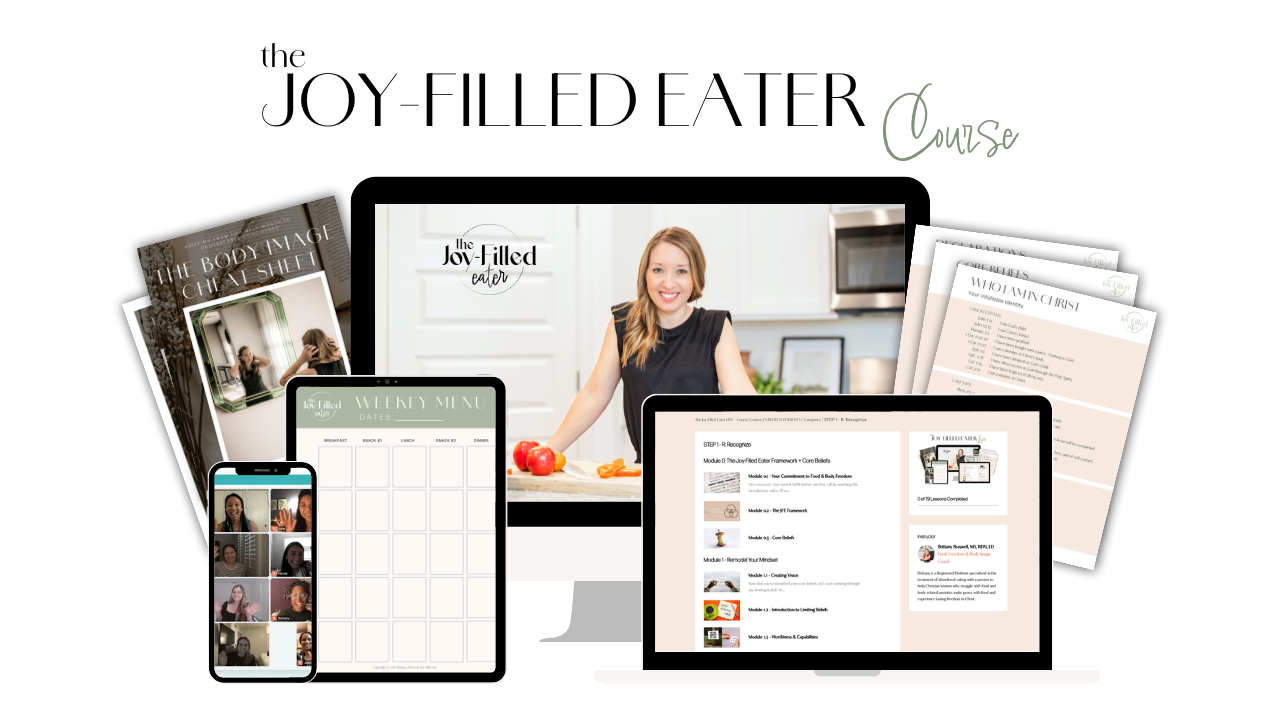
💛 Join the Joy-Filled Eater Course
Inside this Christ-centered program, I walk you step-by-step through dismantling food rules like this one so you can experience true food freedom.
🎧 Subscribe to the Faith-Filled Food Freedom Podcast
For more conversations just like this one.
💬 Connect With Community
Join other women pursuing food freedom in Christ-centered community.
Final Thought
You don’t have to wait for the “best bite” to enjoy your life.
You don’t have to delay satisfaction until everything is perfect.
And you certainly don’t have to turn your plate into a performance.
Food freedom isn’t found in control.
It’s found in presence. Peace. And permission.
And friend… that changes everything.
Until next time—keep chasing joy and choosing freedom.
Stay in touch by subscribing to my personal newsletter, The Full Plate Press
Join over 1000 others and get access to my weekly newsletter with a personal story, BTS sneak peaks, food freedom tips & strategies, riduculous memes, and BONUS goodies from me!
I'm Brittany!
Brittany Braswell, MS, RDN, LD
Host of Faith-Filled Food Freedom & Creator of The Intern Accelerator
I'm here to help Christian women around the world overcome negative body image and an anxiety-ridden relationship with food so they can finally stop stressing and obsessing over how they look and what they eat.