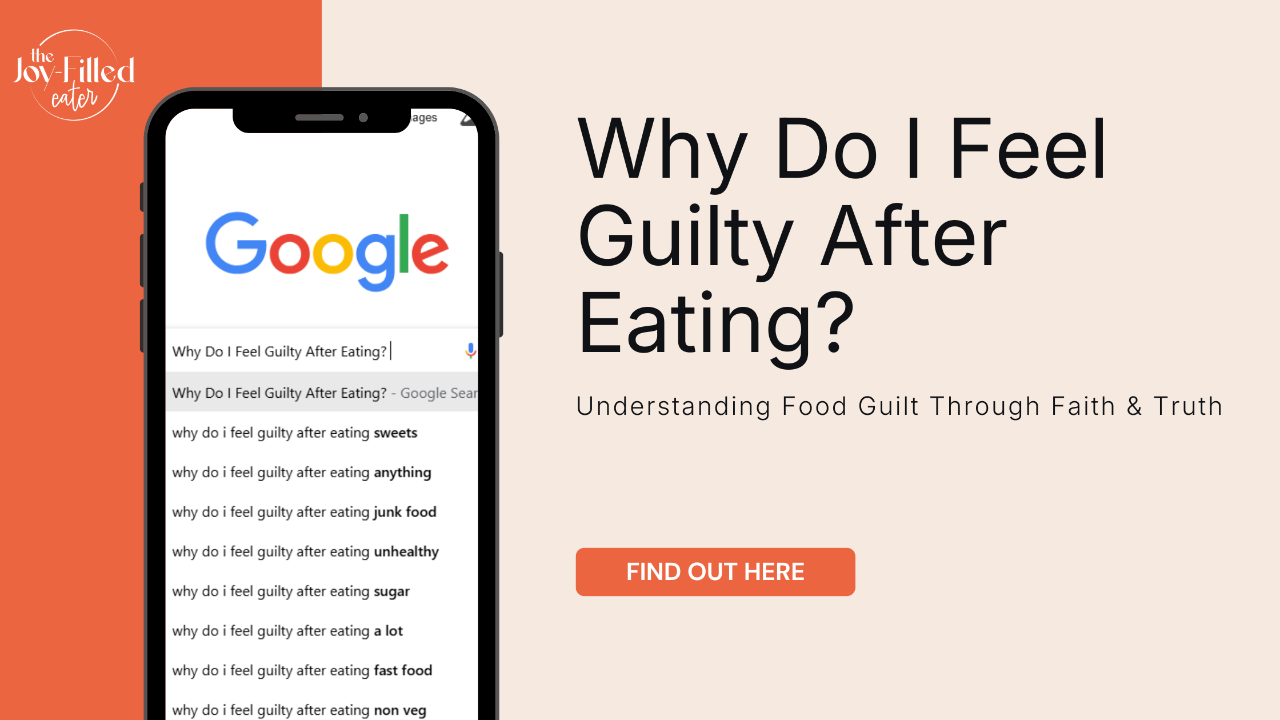
Why Do I Feel Guilty After Eating? Understanding Food Guilt Through Faith and Truth
She scraped the last bite of pasta off her plate, leaned back in her chair, and felt full in the best way.
For about ninety seconds.
Then it hit. That familiar tightening in her chest. The mental replay of every bite. The quiet, insistent voice asking what she was going to do to fix this. One of my clients described this exact moment to me not long ago, and I want you to know something before we go any further.
She isn't the only one who feels this.
If you've ever finished a meal, a totally normal, unremarkable meal, and felt regret wash over you before you even left the table, you're in good company. Food guilt is one of the most common threads I hear woven through the stories of the Christian women I work with. It shows up whether someone grew up counting points at Weight Watchers with her mom or memorizing which foods were "clean" at youth group potlucks. Diet culture and religious pressure have a sneaky way of tag-teaming a woman's relationship with her plate.
So today, we're going to dig into where food guilt actually comes from, why it's lying to you more often than you think, and how to release it through truth and grace instead of white-knuckled willpower.
I only ask one thing of you as you read. Stay curious about your emotions around food instead of critical of them. Curiosity opens doors that criticism slams shut.
What Is Food Guilt and Where Does It Come From?
Food guilt is the emotional weight of believing you did something bad simply by eating. Not something unwise. Not something off-plan. Bad, as in morally wrong, as in you owe someone an apology or a punishment.
It rarely starts in adulthood. Most of the time, food guilt is inherited long before a woman ever chooses her own groceries.
Maybe it came from diet culture, which has spent decades convincing women that thinness equals discipline and discipline equals worth. Maybe it came from a childhood dinner table where cleaning your plate was tied to being a "good girl," or where dessert was a reward you had to earn. And for many Christian women, it came from church culture too, where gluttony got preached about far more than grace ever did, and food quietly became a measuring stick for spiritual maturity.
Over time, these messages stop sounding like outside opinions and start sounding like your own conscience. Food guilt gets internalized as a referendum on your self-worth, and that's a heavy, exhausting way to live.
Take a minute here, if you can. Think back to the first time you remember feeling guilty about something you ate. Who was in the room? What were you told, directly or indirectly, about what that food meant about you? You may be surprised how far back that voice actually goes.
The Myth: "If I Feel Guilty, I Must Have Eaten Wrong"
Here's the belief we need to pull apart first, because it's the foundation everything else gets built on: if I feel guilty, I must have done something wrong.
That sounds logical on the surface. Feelings feel like facts, especially strong ones. But guilt isn't evidence. It's an emotion, and emotions can be shaped by faulty training just like anything else.
Food guilt is learned. It's not God-given, and it's not a spiritual gift.
Scripture actually draws a sharp line for us here. Romans 8:1 says, "There is therefore now no condemnation for those who are in Christ Jesus." Read that again slowly. No condemnation. Not "no condemnation unless you had seconds." Not "no condemnation as long as you tracked it." No condemnation, period, for those who belong to Him.
That verse alone tells us something important about how real conviction from God operates. When the Holy Spirit convicts, it's specific, it's clear, and it leads somewhere productive, usually toward repentance and restored relationship. Conditioned guilt from culture does the opposite. It's vague, it's relentless, and it leads nowhere but shame. It doesn't resolve. It just lingers, ready to attach itself to the next meal and the one after that.
Learning to tell the difference between conviction and conditioning might be one of the most freeing skills you ever develop.
How Food Rules and Perfectionism Fuel Guilt
If food guilt is the fire, food rules are the gasoline.
Strict rules around eating set up expectations no human body was ever designed to sustain. No sugar. No carbs after six. No eating unless you've technically "earned" it through movement first. These rules promise control, but what they actually deliver is a constant low hum of anxiety around something your body needs multiple times a day to survive.
This is where the all-or-nothing mindset creeps in. You know the voice. I was so good today after a salad with dressing on the side. I totally blew it after a slice of birthday cake at your niece's party. There's no middle ground in that framework, only pass or fail, and food becomes the daily report card nobody asked you to fill out.
Perfectionism around eating doesn't create peace. It creates chronic stress and a low-level dissatisfaction that never quite lifts, no matter how "well" you eat.
I want to gently ask you something as you read this. Where might you be striving for control around food instead of trusting your body, and trusting God, to do what they were designed to do? That's not a rhetorical question meant to make you feel worse. It's an honest one, worth sitting with over coffee tomorrow morning.
The Common Mistake: Letting Guilt Dictate the Next Meal
Here's where the cycle really tightens its grip. Guilt shows up after a meal, and instead of just being felt and released, it gets handed the wheel for what happens next.
Sometimes that looks like restriction. You feel guilty about lunch, so dinner becomes smaller, plainer, a kind of penance. Sometimes it looks like overcorrection, an extra workout squeezed in out of punishment rather than care. And sometimes, ironically, guilt leads straight into more emotional eating, because shame is exhausting and food is often the fastest available comfort.
This keeps women stuck in a loop of shame rather than moving them forward into peace. A client once told me she would feel guilty about a bowl of ice cream, restrict the next day to "make up for it," get ravenously hungry by that evening, and eat far past comfortable fullness out of sheer depletion. Then, of course, the guilt would return, and the cycle would start all over again. Her self-talk during those weeks was brutal. Words like lazy and out of control showed up constantly, and none of them were true.
There's a better way to respond to guilt than letting it plan your next meal for you. Respond with curiosity and compassion instead. Ask what the feeling is actually pointing to, rather than immediately obeying it.
5 Steps to Release Food Guilt with Truth and Grace
When guilt shows up after eating, and it will, here's a practical way to meet it without letting it take over.
- Pause and name the feeling. Don't suppress it and don't judge it. Simply notice, I'm feeling guilty right now, the same way you might notice you're tired or cold.
- Ask where the guilt came from. Was it a food rule you've been carrying since college? An old voice from your childhood? A fear about your body changing? Naming the source takes away some of its power.
- Replace the lie with truth. Try something like, this food is not sinful, and my body is not the enemy. Say it out loud if you need to. Sometimes truth needs to be spoken before it feels believable.
- Practice gratitude for the meal. Consider what it actually provided your body: energy, nourishment, maybe even genuine joy at the table with people you love.
- Invite God into the moment. A short, honest prayer works beautifully here. Ask Him for freedom, for renewed perspective, for eyes to see food the way He designed it to be seen.
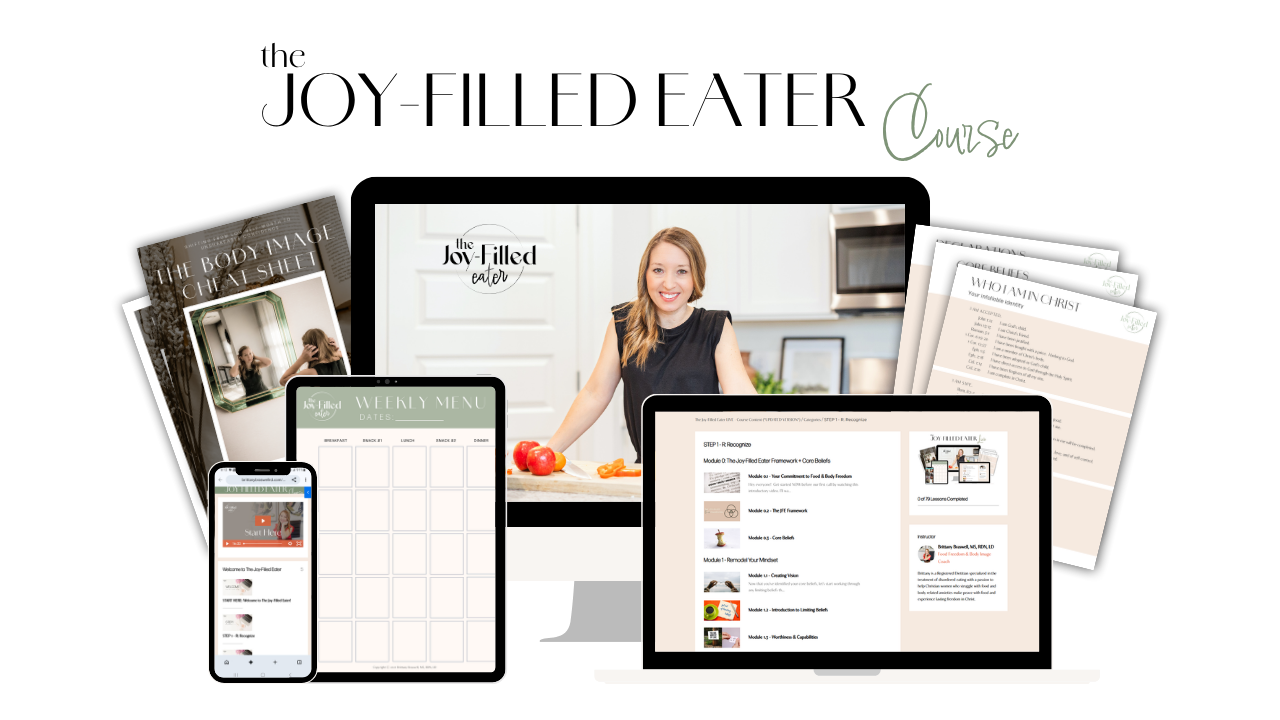
This isn't a one-and-done fix. It's a practice, one you'll return to again and again, and it gets easier with repetition. If you're ready to build these skills in a structured, guided way instead of piecing it together on your own, this is exactly what we walk through step by step inside The Joy-Filled Eater Course.
What Freedom from Food Guilt Looks Like
Freedom from food guilt is quieter than you might expect. It doesn't announce itself with fireworks. It shows up as internal peace, as self-trust, as the ability to eat a meal and simply move on with your day instead of replaying every bite in your head.
I have watched Christian women in this community go from dreading dinner invitations to genuinely enjoying them. Women who used to plan their entire week around what they would "allow" themselves to eat on the weekend, and who now order what actually sounds good on the menu without a second thought. That kind of shift isn't just emotional. It's spiritual, a real embodiment of the grace they've been taught about their whole lives finally reaching their plate.
Freedom looks like small wins that used to feel impossible. Enjoying a slice of dessert at a birthday party without a mental tally running in the background. Honoring hunger cues in the middle of a busy workday instead of overriding them out of habit. These moments aren't small at all. They're the evidence of real transformation.
Frequently Asked Questions
Isn't guilt sometimes a good thing to keep me accountable?
Healthy accountability and food guilt aren't the same thing. Accountability points you toward a clear, specific action and leads somewhere good. Food guilt just circles, vague and relentless, without ever resolving into anything productive. If a feeling after eating leaves you more anxious rather than more grounded, it's likely conditioned guilt, not helpful accountability.
How do I know if it's food guilt or actual conviction from the Holy Spirit?
Conviction from the Holy Spirit tends to be specific and tied to something you can name and address, and it moves you toward restoration rather than shame. Food guilt is usually foggy. It can't point to an actual moral issue because eating isn't one. If you can't articulate exactly what you did "wrong" beyond simply eating, that's a strong sign it's conditioning talking, not conviction.
What if I always feel guilty after eating, no matter what it is?
That pattern usually points to something deeper than any single food choice. It often means the belief system underneath your eating needs attention, not your meals. This is common, and it's absolutely something that can shift with the right support and practice.
Can I still pursue health while letting go of guilt?
Yes, and honestly, it works far better this way. Health pursued from a place of guilt is fragile and short-lived. Health pursued from a place of peace, self-respect, and genuine care for the body God gave you tends to last, because it's not being driven by fear.
Final Thoughts: You Don't Need to Earn the Right to Eat
Nourishment was never meant to be a moral issue. It's part of God's design, built into your body from the very beginning, long before diet culture or anyone else got a say in how you should feel about it.
You don't need to earn the right to eat. You already have it, simply by being human, simply by being you.
Choose grace over guilt today, and choose progress over perfection tomorrow. John 8:36 puts it plainly: "So if the Son sets you free, you will be free indeed." Free, not free-ish. Free indeed, including at the dinner table.
If this topic resonated with you, these podcast episodes go even deeper into overcoming food guilt:
- Episode 49: How to Battle Guilt Before, During, and After Meals
- Episode 211: Why You Overeat: The "Saving the Best for Last" Habit That's Fueling Food Guilt
- Episode 236: Why Do I Feel Guilty After Eating?
Listen to these and more on the Faith-Filled Food Freedom podcast
And if you're ready to stop white-knuckling your way through every meal and finally build a lasting, Christ-centered peace with food, The Joy-Filled Eater Course was made for exactly this moment you're in.
You can also find community and encouragement along the way in our free Facebook group, Food Freedom & Body Image Support for Christian Women.
Keep chasing joy and choosing freedom. See you in the next one!
Stay in touch by subscribing to my personal newsletter, The Full Plate Press
Join over 1000 others and get access to my weekly newsletter with a personal story, BTS sneak peaks, food freedom tips & strategies, riduculous memes, and BONUS goodies from me!
I'm Brittany!

Brittany Braswell, MS, RDN, LD
Host of Faith-Filled Food Freedom & Creator of The Intern Accelerator
I'm here to help Christian women around the world overcome negative body image and an anxiety-ridden relationship with food so they can finally stop stressing and obsessing over how they look and what they eat.