THIS is Why Your Thoughts Won’t Shut Up (and the Biblical Way to Finally Quiet Them)

Ever feel like your brain has 47 tabs open… and somewhere in the background, one of them is playing emotional damage on full volume? 🫠
You’re unloading the dishwasher, packing lunches, answering work emails, trying to remember if you switched the laundry over… and meanwhile your brain is over here like:
- “You really shouldn’t have eaten that.”
- “You need to get back on track Monday.”
- “Why can’t you just have more self-control?”
- “Did you see how your stomach looked in that mirror earlier?”
Whaaaat?! Exhausting.
And if you’ve ever sat there wondering, “Why can’t I just stop thinking about food and my body all the time?” — friend, you are not crazy. You are not weak. And you are definitely not the only Christian woman struggling with this.
In fact, one of the biggest lies I see women believing is that if they just had more willpower or more discipline or were a “better Christian,” they’d finally be able to “take every thought captive” and move on with their lives.
But food freedom? Improved body image? Renewing your mind?
That takes intentionality.
And here’s the good news: your brain can actually be retrained.
Not through toxic positivity.
Not through pretending hard thoughts don’t exist.
And definitely not through shaming yourself into “thinking happy thoughts.”
But through a Christ-centered process of renewing your mind with truth.
So today, we’re diving into the real reason your thoughts won’t shut up — plus the biblical and brain-based strategy that can finally help you experience more peace around food, your body, and your thoughts.
Your Brain Was Never Designed to Be Quiet
Let’s start here because this matters.
So many women assume that if they still struggle with obsessive food thoughts, body image anxiety, comparison, or mental spiraling, something must be wrong with them.
But friend? Your brain is not broken.
It’s just overloaded.
Think about your laptop for a second. You know when you have 25 tabs open and suddenly your computer sounds like it’s preparing for liftoff? 😂
One tab has a recipe.
One has Amazon open.
Another has your kid’s school calendar.
Spotify is randomly playing music from somewhere.
And then suddenly an ad starts talking and you’re frantically clicking around trying to figure out WHERE THE SOUND IS COMING FROM.
That’s what your brain can feel like when food noise and body image thoughts take over.
One thought triggers another.
“I ate too much.”
…which leads to:
“I need to work out tomorrow.”
…which turns into:
“I’ve really let myself go lately.”
…and suddenly you’re comparing yourself to another woman at church, thinking about your jeans fitting tighter, and mentally planning a cleanse you swore you were never doing again.
Oy vey.
What Is the Default Mode Network? (And Why It Matters for Food Freedom)
One of the concepts we talked about on the podcast is something called the Default Mode Network (DMN).
Now before you panic and think, “Brittany, girl… this sounds science-y.” Stay with me. I promise this matters.
Your default mode network is basically your brain’s background operating system. It’s active when your brain is not intentionally focused on a task.
Translation?
It’s where your mind tends to wander.
And for many women struggling with disordered eating or body image issues, those wandering thoughts often drift toward:
- Body comparison
- Food guilt
- Anxiety
- Shame
- “Should” thoughts
- Fear around weight gain
- Mental food rules
- Obsessive self-evaluation
Friend, your brain naturally defaults somewhere. The issue is not whether your mind wanders.
The issue is where it wanders.
And if your brain has spent years rehearsing thoughts like:
- “My body isn’t good enough.”
- “I can’t trust myself around food.”
- “I need to lose weight to feel confident.”
- “Good women are disciplined eaters.”
…then those mental pathways become very familiar.
Not because they’re true.
But because they’re practiced.
The Reticular Activating System: Why You Keep Noticing “Evidence”
Okay, now let’s talk about the Reticular Activating System (RAS).
This part of your brain acts like a filter. It helps determine what gets your attention and what gets ignored.
Think about when you decide you want a specific car.
Suddenly? You see it EVERYWHERE.
That car was always there. Your brain just started noticing it because now it matters to you.
The same thing happens with body image and food thoughts.
If your brain is constantly rehearsing:
- “I hate my stomach.”
- “I’m failing at healthy eating.”
- “I have no self-control.”
…your brain starts scanning for evidence to support those beliefs.
You notice:
- Every perceived flaw
- Every comparison
- Every uncomfortable body sensation
- Every “off plan” food choice
Not because those things define reality.
But because your brain has been trained to focus there.
Read that again because this part matters:
Just Because You’re Seeing It Doesn’t Mean You’re Seeing Reality
Whew. That’ll preach.
Just because you’re noticing something does not automatically make it true.
It simply means your brain has been conditioned to pay attention to it.
And honestly? That should give you hope.
Because if your brain can learn those patterns… it can also learn new ones.
What the Bible REALLY Means by “Take Every Thought Captive”
One of the most quoted verses in Christian mental health conversations is:
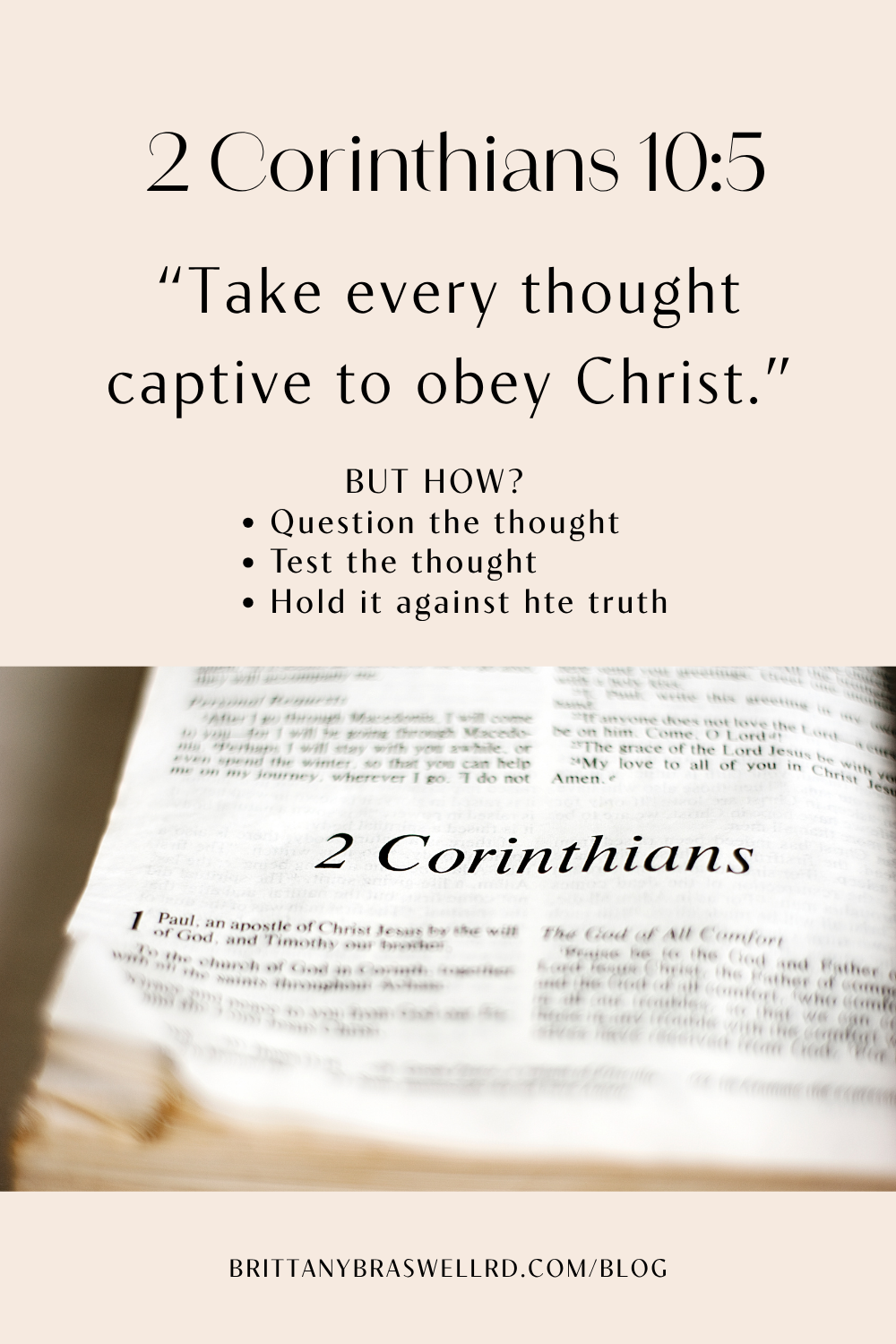
“Take every thought captive to obey Christ.” — 2 Corinthians 10:5
But let’s be honest for a second.
Most women hear that verse and think:
“Okay cool… but HOW?!”
Because when your brain feels loud and chaotic, “just think differently” can feel wildly unhelpful.
But here’s what’s important:
Taking thoughts captive is not passive.
It’s active.
In the original Greek, the phrase literally points toward bringing something under control.
Not ignoring it.
Not pretending it isn’t there.
Not stuffing it down with a protein bar and a positive affirmation. 😉
It means engaging with intention.
Questioning the thought.
Testing it.
Holding it up against truth.
Because not every thought deserves your agreement.
And honestly? Some thoughts deserve a direct “absolutely not” from you.
Stop Believing Every Thought Automatically
Can I lovingly say something a little bold?
Stop believing every thought your brain throws at you.
Seriously.
You don’t have to automatically agree with every fearful, shame-filled, body-obsessed thought that enters your mind.
You have permission to challenge it.
To question it.
To ask:
- “Is this actually true?”
- “Does this align with God’s truth?”
- “Would I say this to a friend?”
- “Is this thought producing life or bondage?”
Because here’s what happens when we don’t challenge our thoughts:
We build entire emotional reactions on top of them.
One thought becomes a spiral.
And suddenly we’re emotionally reacting to something that may not even be true.
The Biblical Framework That Helps Quiet Food Noise
One of my favorite frameworks from therapist Jo Hargreaves on the Faith-Filled Therapy podcast is this:
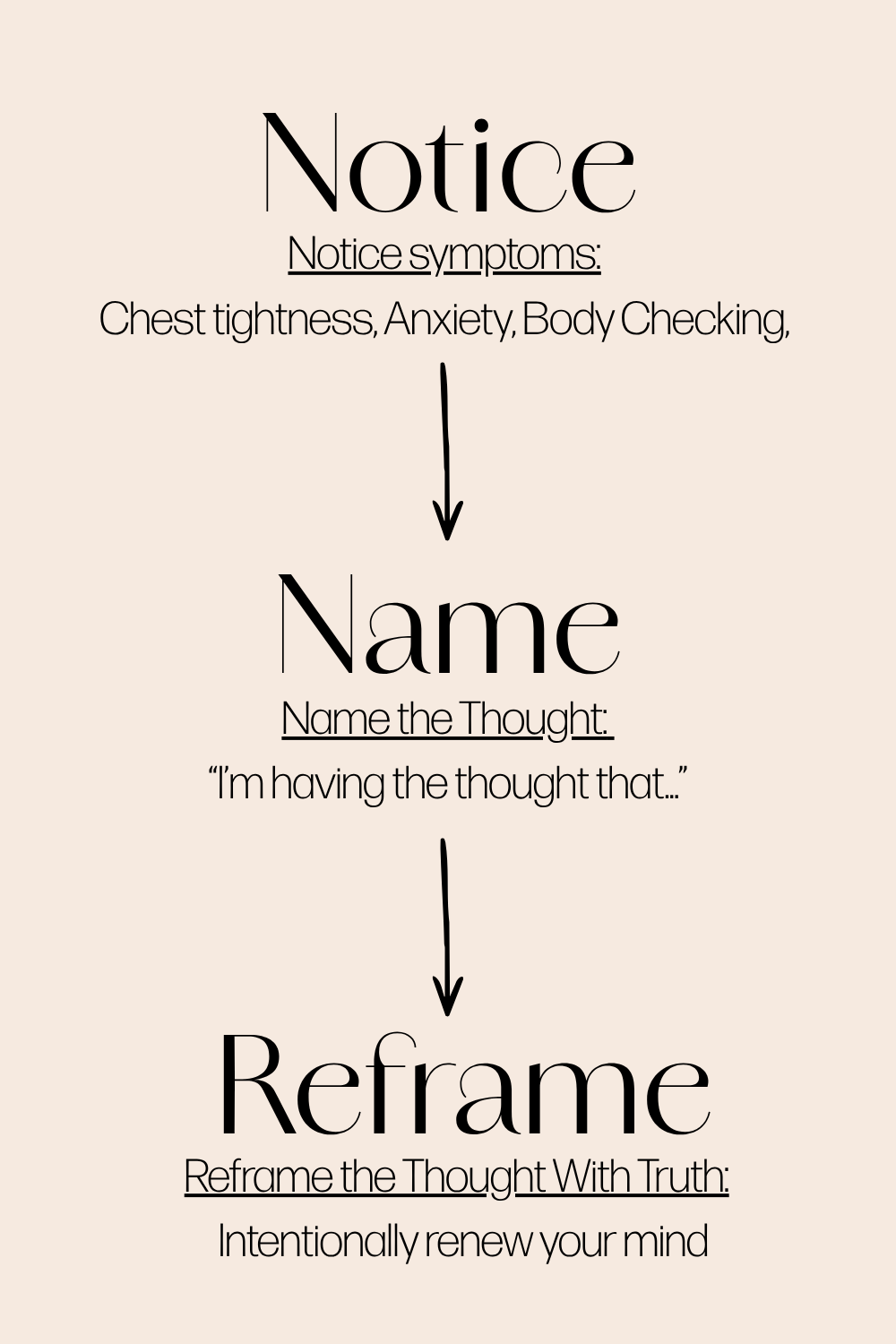
Notice → Name → Reframe
Simple. Practical. Powerful.
Let’s walk through it.
1. Notice the Thought
Awareness interrupts autopilot thinking.
Whew. SO good.
Before you can change a thought pattern, you have to recognize it’s happening.
You may notice:
- Tightness in your chest
- Anxiety after eating
- Mental spiraling
- Obsessive body checking
- Urgency to restrict or compensate
- Shame after eating certain foods
This is where you pause and go:
“Okay… something’s happening here.”
Not judgment.
Just awareness.
2. Name the Thought
Instead of instantly agreeing with the thought, create some separation from it.
Try saying:
- “I’m having the thought that…”
- “A part of me believes…”
- “The story I’m telling myself is…”
This matters because naming your thoughts helps reduce emotional reactivity and brings your logical brain back online.
Instead of:
“I have no self-control.”
You shift to:
“I’m having the thought that I have no self-control.”
That tiny language shift? Huge difference.
Because now the thought is something you’re observing — not automatically accepting as truth.
3. Reframe the Thought With Truth
This is where renewal happens.
Not fake positivity.
Not “I love my body every second of every day.”
This is about anchoring yourself in truth.
For example:
Instead of:
“I completely messed up.”
Try:
“I’m learning consistency and grace.”
Instead of:
“My body isn’t good enough.”
Try:
“My body is not my standard. God’s truth is my standard.”
Friend, renewing your mind is not accidental work.
It’s intentional work.
Romans 12:2 and the Science of Brain Renewal
Romans 12:2 says:
“Do not be conformed to this world, but be transformed by the renewal of your mind…”
Isn’t it incredible how modern neuroscience keeps catching up to what Scripture has said all along?
Research on neural pathways and cognitive restructuring shows that repeated thoughts literally strengthen specific pathways in the brain.
Meaning:
The more you rehearse a thought, the stronger that pathway becomes.
But here’s the hopeful part:
New pathways can also be built.
Every time you:
- challenge a distorted thought,
- replace a lie with truth,
- refuse to rehearse shame,
- meditate on Scripture,
- practice grace instead of punishment…
…you are strengthening new mental pathways.
You are teaching your brain a new direction.
Not overnight.
Not perfectly.
But intentionally.
And friend? That matters.
Food Freedom Starts With Mental Freedom
Here’s what I need you to hear today:
You are not stuck with the thoughts you have right now.
Even if:
- food noise feels constant,
- body image struggles feel consuming,
- anxiety around eating feels exhausting,
- or you’ve spent YEARS trapped in diet culture thinking…
Change is possible.
Not because you suddenly become more disciplined.
But because God created your brain with the ability to renew and change.
That doesn’t mean every thought disappears overnight.
But it does mean you can stop letting every thought have automatic authority over you.
Practical Ways to Start Renewing Your Mind Around Food and Body Image
If you want somewhere tangible to start, here are a few practical steps:
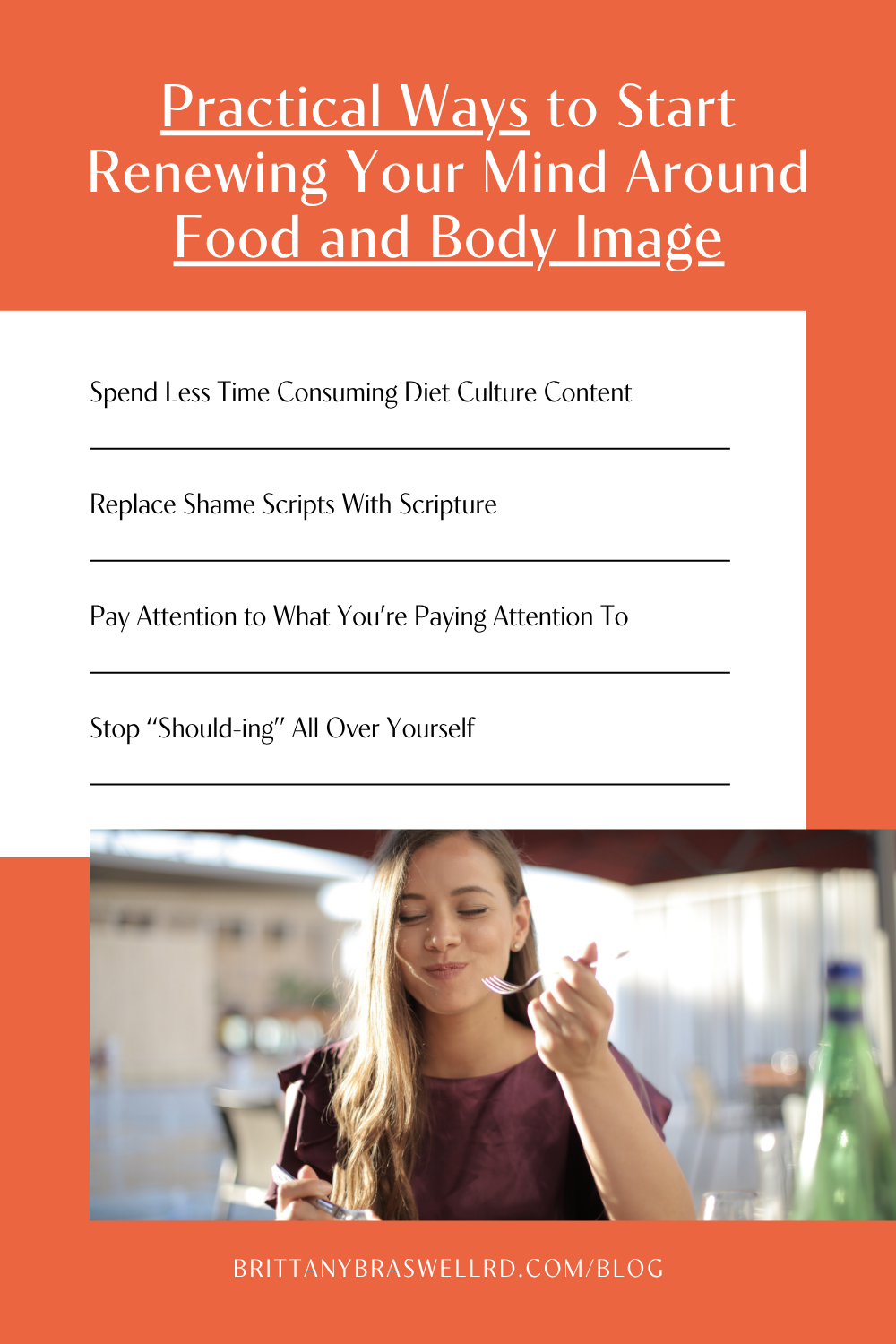
Spend Less Time Consuming Diet Culture Content
Friend, if your social media feed constantly tells you:
- shrink your body,
- earn your food,
- detox your life,
- “bounce back,”
- or fear carbs…
…it’s no wonder your brain feels loud.
Your thoughts are shaped by repetition.
Protect your mental environment.
Replace Shame Scripts With Scripture
Instead of rehearsing:
“I should be smaller.”
Try meditating on:
- Philippians 4:8
- Romans 12:2
- 2 Corinthians 10:5
Scripture gives your mind somewhere new to go.
Pay Attention to What You’re Paying Attention To
This quote from Dr. Curt Thompson is SO good:
“Pay attention to what you’re paying attention to.”
Friend… what are you mentally rehearsing all day?
Because what you repeatedly focus on becomes easier for your brain to find.
Stop “Should-ing” All Over Yourself 😅
Can we retire the phrase:
“I should be better at this by now.”
Please and thank you.
Healing is not linear.
And shame is not a sustainable growth strategy.
You Don’t Have to Fight These Thoughts Alone
If this post had you nodding along thinking, “Oh wow… this is exactly what’s happening in my brain,” first of all: welcome. You are in very good company here.
And second? There is support available.
If you want help walking through these thought patterns in a practical, Christ-centered way, I’d love for you to explore the Joy-Filled Eater course, where we dive deeper into renewing your mind, improving body image, and breaking free from obsessive food thoughts.
And friend, if this conversation encouraged you, here are a few next steps:
-
Subscribe to the Faith-Filled Food Freedom Podcast on Apple Music
-
Join our free community here
-
Sign up for the Full Plate Press newsletter here: Full Plate Press VIP List
Because food freedom is possible.
Not perfectly.
Not instantly.
But one renewed thought at a time.
And as always, friend — keep chasing joy and choosing freedom.
Stay in touch by subscribing to my personal newsletter, The Full Plate Press
Join over 1000 others and get access to my weekly newsletter with a personal story, BTS sneak peaks, food freedom tips & strategies, riduculous memes, and BONUS goodies from me!
I'm Brittany!

Brittany Braswell, MS, RDN, LD
Host of Faith-Filled Food Freedom & Creator of The Intern Accelerator
I'm here to help Christian women around the world overcome negative body image and an anxiety-ridden relationship with food so they can finally stop stressing and obsessing over how they look and what they eat.