The Hidden Damage of Restricting: How It Impacts Your Bones & Period
Let’s just go ahead and say the quiet part out loud…
You don’t have to “look sick” for your body to be struggling.
Whaaaat?! I know. Not exactly what diet culture taught you.
Because somewhere along the way, many of us started believing:
“If my labs are normal… if my weight is ‘fine’… if I still function day-to-day… then I must be okay.”
Friend… that is one of the biggest lies keeping women stuck.
And if you’ve ever thought:
- “It’s not that bad.”
- “I’m just trying to be healthy.”
- “I don’t think I need help.”
This post is for you. 💛
Today, we’re diving into something that doesn’t get talked about enough—how restriction and underfueling impact your bone health and menstrual cycle. Not in a fear-based way. Not in a shame-based way.
But in a truth-telling, grace-filled, let’s-care-for-the-body-God-gave-you kind of way.
The Hidden Cost of Restriction (That No One Talks About)
Here’s the thing about restriction…
It rarely starts out extreme.
It starts with:
- Cutting out certain foods
- Trying to “eat cleaner”
- Being more disciplined
- Wanting to feel in control
All things that sound healthy, right?
But over time?
It can quietly shift into:
- Skipping meals
- Ignoring hunger cues
- Over-exercising
- Constant food thoughts
- Anxiety around eating
And here’s where it gets tricky…
Your body is incredibly adaptive. It will do everything it can to keep you alive—even when you’re not giving it enough fuel.
But that survival mode comes at a cost.
What Happens to Your Body When You Undereat
Let’s break this down simply.
When your body isn’t getting enough energy, it has to prioritize.
Think of it like a budget.
If money (aka fuel) is tight, what do you do?
You cut “non-essential” expenses.
Your body does the same thing.
It says:
“Okay… we need to keep the heart beating and the brain functioning… so what can we reduce or shut down?”
And guess what gets pushed to the back burner?
- Reproductive health (your menstrual cycle)
- Bone building
- Digestion
- Hormone production
Yep. All the things you probably don’t want compromised.
Let’s zoom in on two of the biggest ones…
How Restriction Affects Your Menstrual Cycle (Amenorrhea Explained)
What is Amenorrhea?
Amenorrhea = the absence of a menstrual cycle.
This can look like:
- Losing your period for 3+ months
- Irregular cycles
- Never starting a cycle in adolescence
And one of the most common causes in women who underfuel?
👉 Hypothalamic amenorrhea
(Stay with me—we’re keeping this simple 😉)
Your Body’s “Control Center” Hits Pause
There’s a part of your brain called the hypothalamus. Think of it as your body’s control center.
When you’re nourished and safe, it sends signals like:
- “We have enough energy!”
- “Let’s support hormone production!”
- “Let’s prepare for potential pregnancy!”
But when you’re under-eating or over-stressed?
It says:
“This is not a safe environment for reproduction.”
So it shuts things down.
No signal → no estrogen → no ovulation → no period.
“But Losing My Period Isn’t That Big of a Deal… Right?”
Oh friend… I wish that were true.
I hear this all the time:
“It’s actually kind of convenient.”
No tampons. No cramps. One less thing to think about.
But here’s the reality:
Your period is a vital sign.
Losing it isn’t a “bonus”—it’s a warning sign.
It’s your body saying:
“I don’t have what I need to function properly.”
Why Estrogen Matters (Hint: It’s Not Just About Babies)
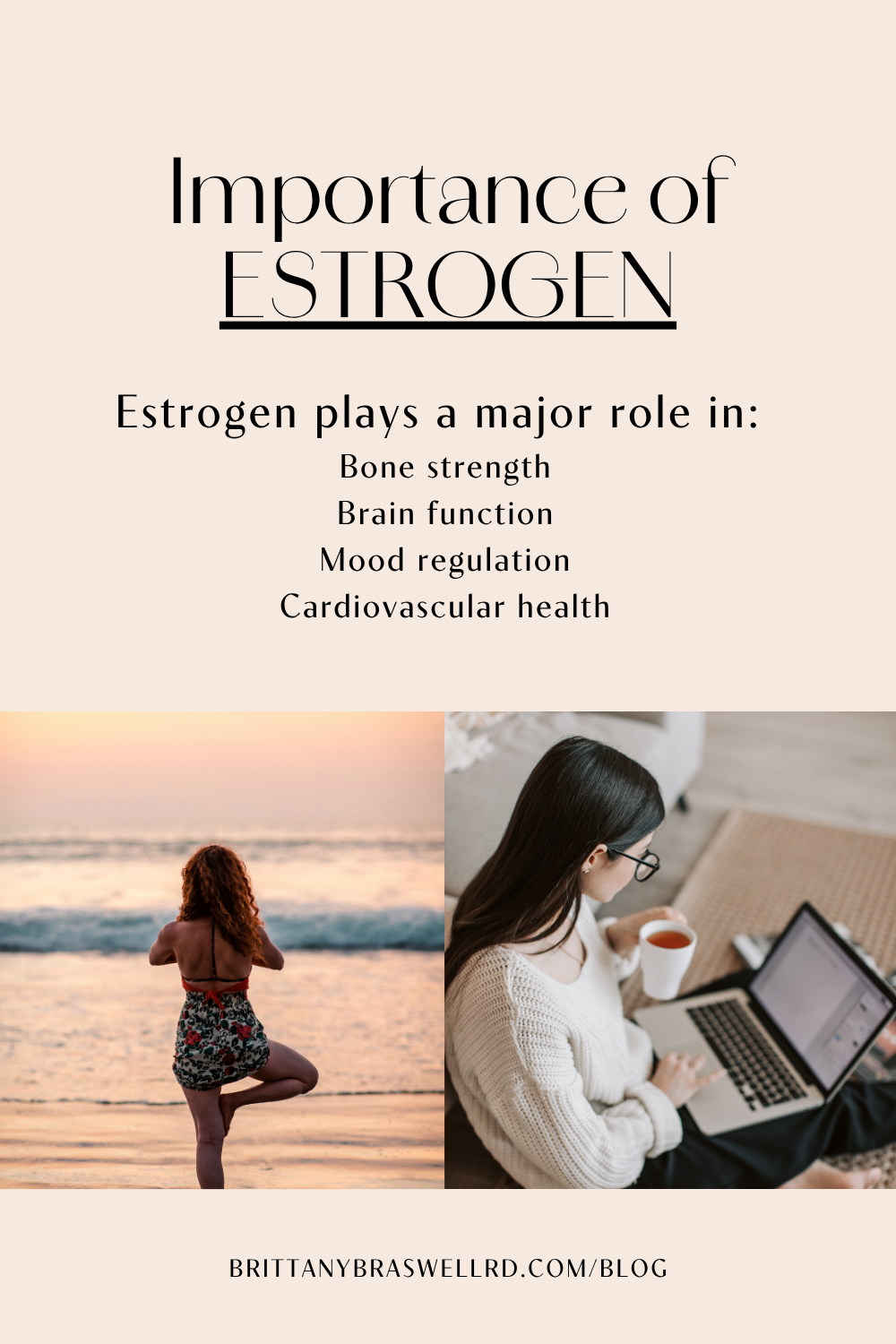
Estrogen does so much more than regulate your cycle.
It plays a major role in:
- Bone strength
- Brain function
- Mood regulation
- Cardiovascular health
So when estrogen drops due to restriction?
It doesn’t just affect your cycle.
It affects your entire body.
The Link Between Restriction and Bone Health
Okay, let’s talk bones. 🦴
Because this one?
It’s a big deal.
Your Bone-Building Years Are Limited
Between roughly ages 17–25, your body is in its prime bone-building window.
This is when you’re laying the foundation for your future bone health.
And here’s the kicker…
👉 You don’t get those years back.
Oy vey.
What Happens When You Restrict During This Time?
When your body isn’t getting enough fuel:
- Estrogen drops
- Bone formation slows
- Bone breakdown increases
Over time, this can lead to:
- Osteopenia (low bone density)
- Osteoporosis (weakened bones)
- Increased risk of fractures
And this can start within months of losing your cycle.
Not years.
Months.
“But I Work Out! Doesn’t That Help My Bones?”
I hear this one a lot.
And the answer is…
👉 It depends.
If you’re:
- Nourished
- Rested
- Supporting your body
Then yes—movement can support bone health.
But if you’re:
- Restricting food
- Over-exercising
- Chronically stressed
Then more exercise = more stress = more cortisol.
And high cortisol?
- Disrupts hormones
- Impairs bone building
- Keeps your body in survival mode
So no… pushing harder isn’t the solution here.
The Cortisol Connection (Stress, Restriction & Your Cycle)
Let’s connect a few dots.
When you’re under-eating, your body perceives that as stress.
So it increases cortisol (your stress hormone).
Now your body is juggling:
- Low energy availability
- High stress
- Hormonal imbalance
And your hypothalamus (that control center)?
It’s overwhelmed.
So again… reproductive health gets deprioritized.
Early Warning Signs You Shouldn’t Ignore
Here’s where I want you to gently check in with yourself.
Not with shame. Not with panic.
Just awareness. 💛
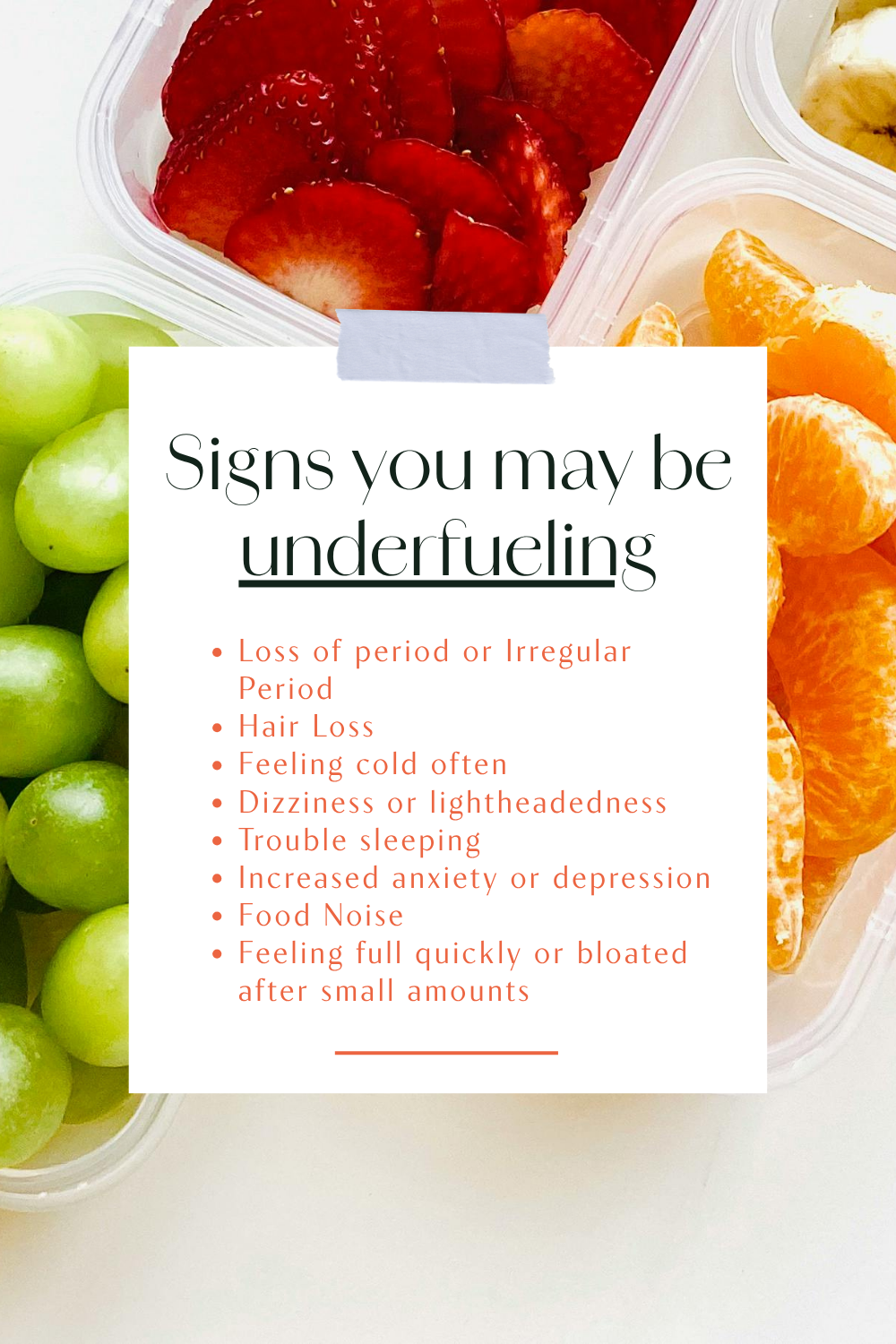
Some early signs of underfueling include:
- Missing or irregular periods
- Hair loss
- Feeling cold often
- Dizziness or lightheadedness
- Trouble sleeping
- Increased anxiety or depression
- Obsessive food thoughts (“food noise”)
- Feeling full quickly or bloated after small amounts
Sound familiar?
Even one or two of these can be your body waving a little flag saying:
“Hey… I need more support.”
“But My Labs Are Normal…”
Let’s talk about this for a second.
Because this is where a lot of women get stuck.
You go to the doctor…
They run labs…
Everything comes back “normal”…
And you think:
“See? I’m fine.”
But here’s the truth:
Normal labs do not always mean optimal health.
Your body is smart.
It will compensate for as long as it can.
But that doesn’t mean there isn’t a problem.
Why You Are “Sick Enough” to Deserve Support
I’m going to say this as clearly as I can:
👉 You do not have to hit rock bottom to get help.
👉 You do not have to be underweight.
👉 You do not need a diagnosis to deserve support.
If your relationship with food feels:
- Stressful
- Obsessive
- Fear-driven
That is enough.
You are enough.
And you are worthy of care. Period.
What Healing Actually Looks Like (And Why It Can Feel Hard at First)
Now let’s be real for a second…
Recovery isn’t always comfortable.
In fact, sometimes it feels harder before it feels better.
You might experience:
- Bloating
- Fullness
- Digestive discomfort
- Fatigue
- Emotional ups and downs
And your brain might say:
“See? This isn’t working.”
But what’s actually happening?
Your body is saying:
“Finally… I can start repairing.”
It’s learning to trust you again.
And that takes time.
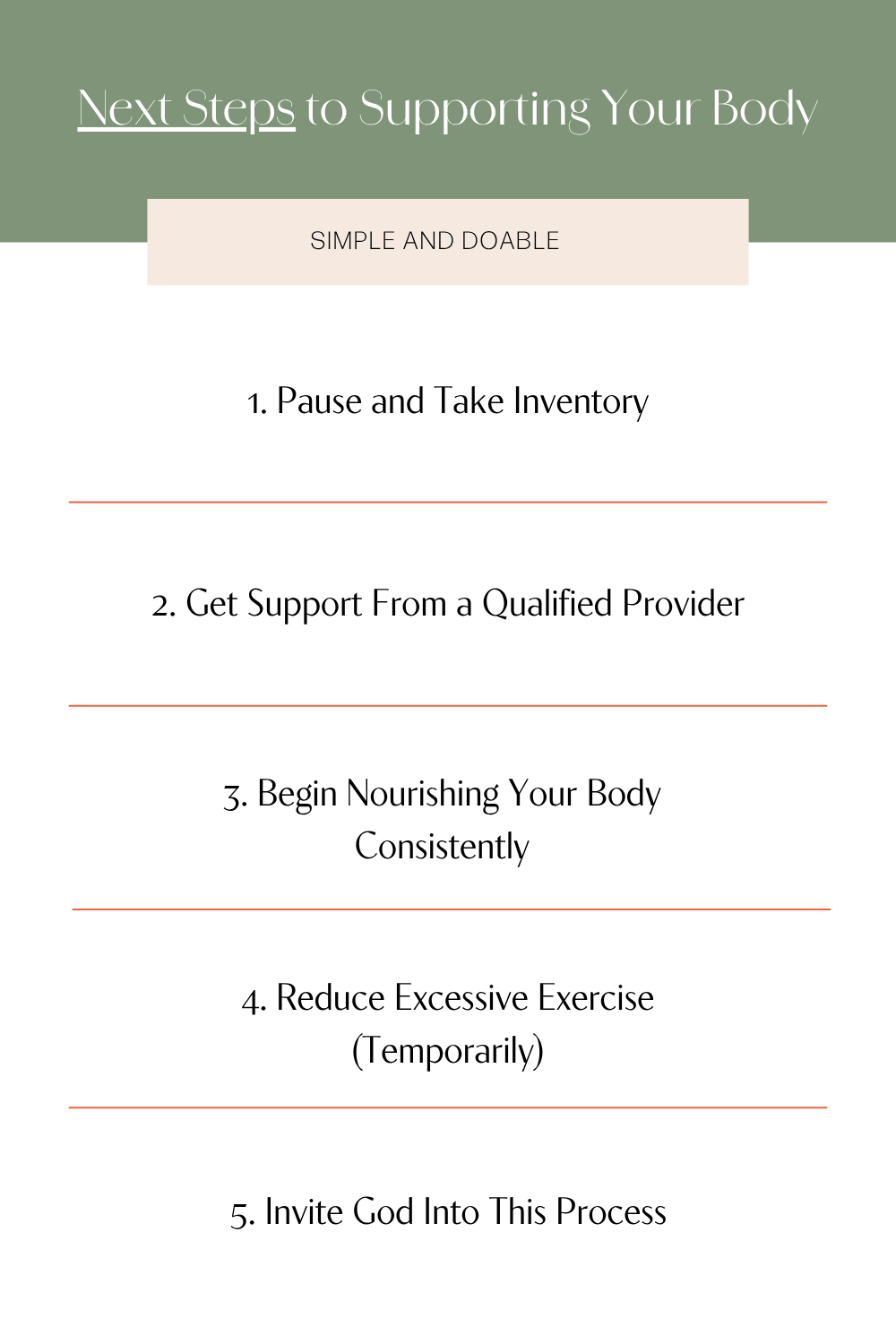
Practical Next Steps to Support Your Body
Okay, so what do you do with all of this?
Let’s keep it simple and doable.
1. Pause and Take Inventory
Before you change anything…
Just pause.
Ask yourself:
- Am I constantly thinking about food or my body?
- Am I ignoring hunger cues?
- Am I afraid of certain foods?
- Have I noticed any physical symptoms?
Not to judge.
Just to notice.
2. Get Support From a Qualified Provider
This is huge.
Look for:
- A dietitian experienced in disordered eating
- A medical provider who understands underfueling
- A therapist if needed
⚠️ Not all providers are trained in this area.
And unfortunately, some may dismiss your concerns.
If that happens?
Keep advocating for yourself.
3. Begin Nourishing Your Body Consistently
This isn’t about perfection.
It’s about consistency.
- Regular meals
- Adequate portions
- Variety of foods
And yes… this may feel uncomfortable at first.
That’s okay.
4. Reduce Excessive Exercise (Temporarily)
I know, I know… this one can feel hard.
But if your body is in a stressed, underfed state?
It needs rest more than it needs intensity.
5. Invite God Into This Process
Because this?
Isn’t just physical.
It’s deeply spiritual too.
You were created intentionally.
Your body is not a problem to fix—it’s a gift to steward.
“Do you not know that your bodies are temples of the Holy Spirit…” (1 Corinthians 6:19)
What would it look like to care for your body from that place?
You Don’t Have to Do This Alone 💛
If this post had you thinking:
“Okay… maybe this is me.”
First of all—deep breath.
Second—you don’t have to figure this out by yourself.
🎧 Keep Learning
Subscribe to the podcast:
👉 Faith-Filled Food Freedom Podcast on Apple Music
💬 Find Community
Join women walking this same journey:
👉 Join the community
Final Encouragement
Friend, if no one has told you this lately:
You don’t have to earn rest.
You don’t have to earn food.
You don’t have to earn care.
Your body is worthy of nourishment right now.
Not when things get worse.
Not when you hit a certain number.
Right now.
And healing?
It starts with one small, brave step forward. 💛
Stay in touch by subscribing to my personal newsletter, The Full Plate Press
Join over 1000 others and get access to my weekly newsletter with a personal story, BTS sneak peaks, food freedom tips & strategies, riduculous memes, and BONUS goodies from me!
I'm Brittany!

Brittany Braswell, MS, RDN, LD
Host of Faith-Filled Food Freedom & Creator of The Intern Accelerator
I'm here to help Christian women around the world overcome negative body image and an anxiety-ridden relationship with food so they can finally stop stressing and obsessing over how they look and what they eat.