How to Quiet the Eating Disorder Voices So You Can Grow Closer to God
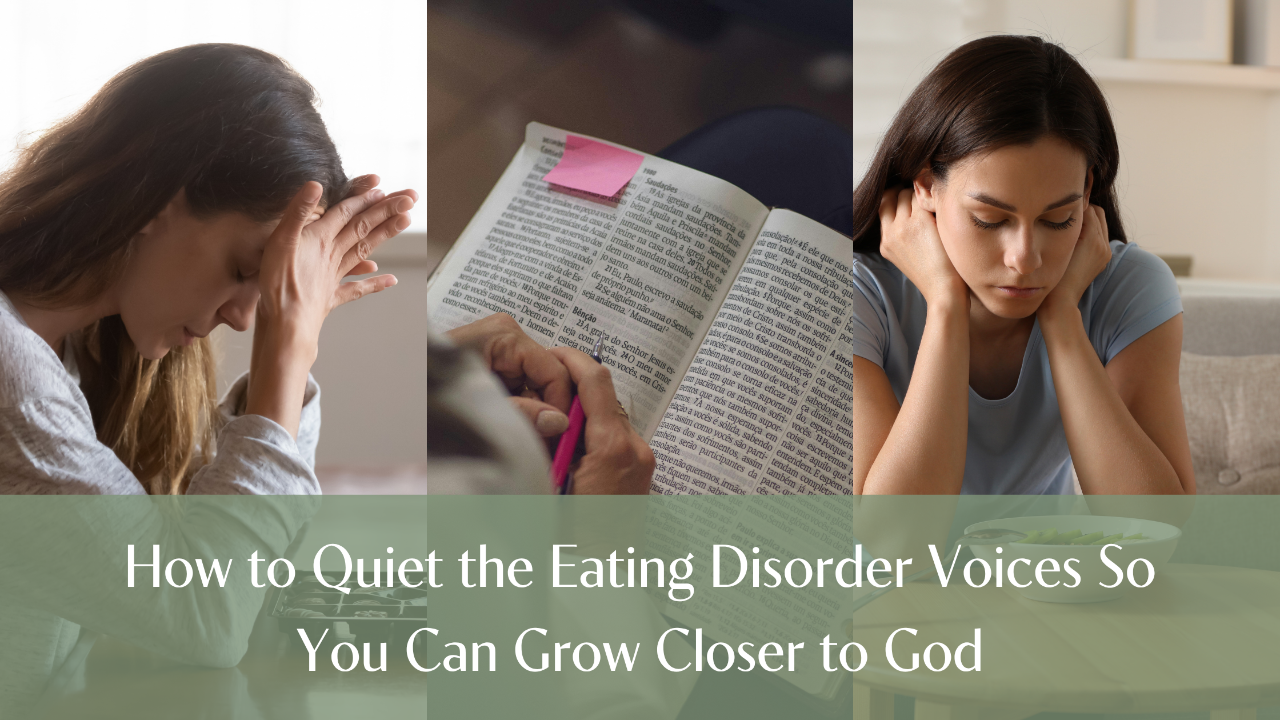
You love Jesus.
You genuinely want to trust Him more.
You want to spend time in His Word without your brain spiraling into thoughts about calories, exercise, your body, or what you're "allowed" to eat today.
But instead?
The eating disorder voice seems to have a microphone while God's voice feels like a whisper.
Friend, if you've ever wondered...
"Why does my mind feel so loud?"
"Why can't I seem to hear God over all these food and body thoughts?"
"How do I stop obsessing so I can actually grow in my faith?"
...you're not alone.
In fact, this question came directly from one of our podcast listeners during the You Asked For It series on the Faith-Filled Food Freedom podcast, and I honestly think it's one of the most important questions we could ask.
Because here's the truth:
Healing your relationship with food isn't separate from your relationship with God.
They're beautifully connected.
When your mind is consumed with food rules, body checking, guilt, shame, and anxiety, it's incredibly difficult to experience the peace, freedom, and intimacy with Christ that He desires for you.
The good news?
The eating disorder voice doesn't have to stay the loudest voice in your life.
Let's talk about how to start changing that.
Why the Eating Disorder Voice Feels So Loud
Before we jump into practical strategies, I want to acknowledge something.
If you're struggling with disordered eating or chronic body image concerns, you're not weak.
You're not "bad" at being a Christian.
And you're certainly not beyond hope.
The eating disorder voice becomes loud because you've likely been listening to it for years.
Maybe decades.
Every diet...
Every compliment about weight loss...
Every social media comparison...
Every food rule...
Every "I'll be happier when..." thought...
Little by little, those messages become familiar.
And familiar thoughts begin to sound like truth.
That's exactly why healing isn't simply about changing behaviors.
It's about changing what you believe.
Step 1: Stop Automatically Obeying the Eating Disorder Voice
This might sound overly simple, but hear me out.
One of the most powerful ways to quiet the eating disorder voice is by refusing to keep doing what it's tells you to do.
I know.
You're probably thinking...
"Well...if it were that easy, I'd already be doing it."
I get it.
Because here's the catch.
You can't consistently disobey the eating disorder until you know what it's actually saying.
That's where identifying your core beliefs becomes so important.
Your Core Beliefs Shape Your Recovery
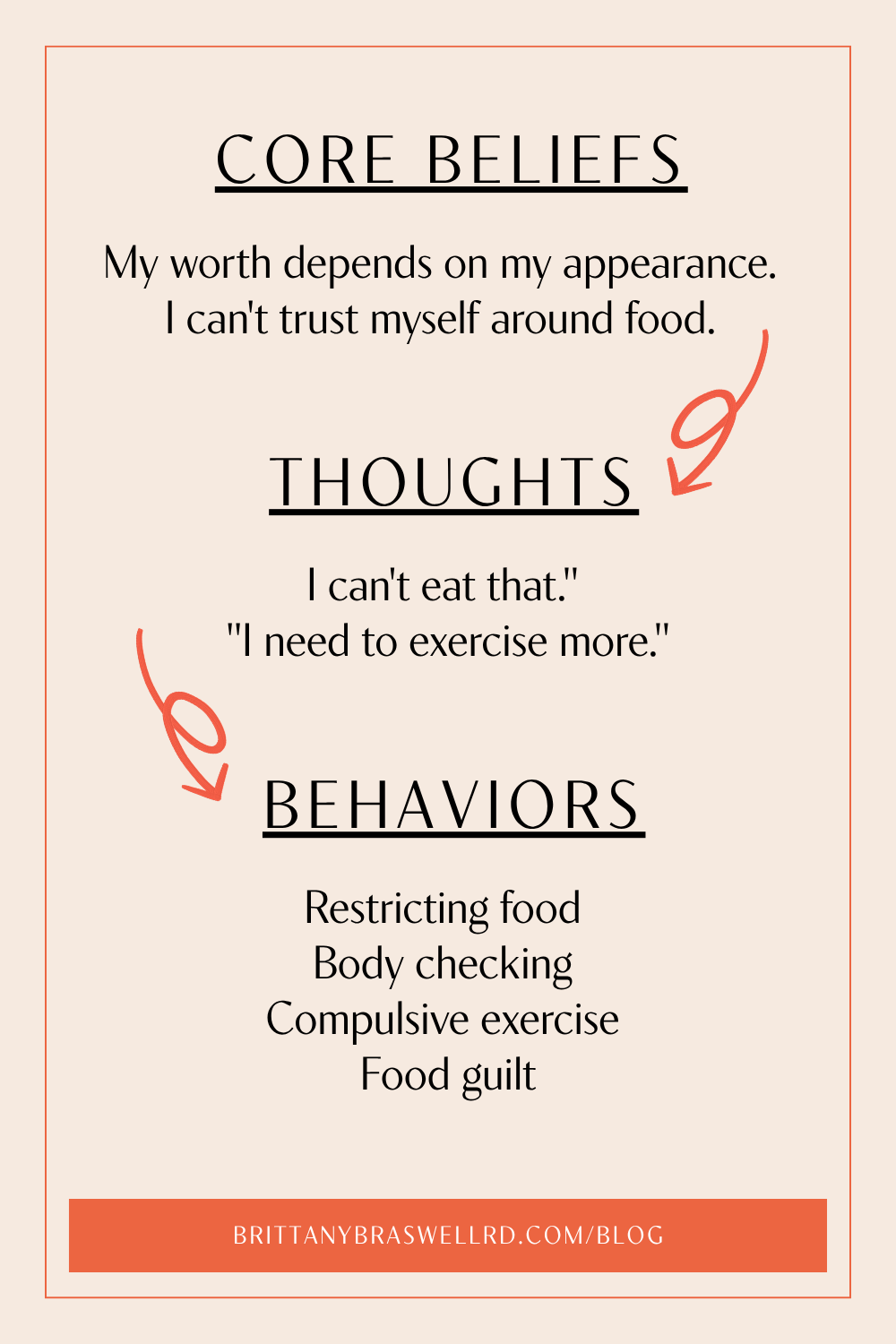
Core beliefs are the deeply rooted things you believe to be true about yourself—even if you've never consciously said them out loud.
Some might sound like:
- My worth depends on my appearance.
- I have to earn rest.
- If I gain weight, people won't love me.
- I can't trust myself around food.
- My body is always the problem.
Those beliefs quietly influence every decision you make.
And until you identify them, it's almost impossible to separate:
- Your own thoughts
- The eating disorder's lies
- The Holy Spirit's leading
That's why healing always starts below the surface.
Identify the Limiting Beliefs Keeping You Stuck
Not every belief needs the same strategy.
This is something I teach extensively inside the Joy-Filled Eater Course because understanding why you believe something changes how you challenge it.
Many limiting beliefs fall into four major categories:
1. Worthiness
Do you believe you have to earn love?
Do you believe God is more pleased with you when your body looks a certain way?
2. Capability
Do you secretly believe you'll never change?
That food freedom is for everyone else—but not for you?
3. Control
Do you feel like controlling food feels safer than trusting God?
This one is sneaky.
Sometimes our obsession with food isn't really about food at all.
It's about trying to create certainty in an uncertain world.
4. Possibility
Do you actually believe healing is possible?
Or does recovery feel like something that's only available to other women?
Once you begin identifying these patterns, you're no longer blindly reacting.
You're intentionally challenging the lies.
And that's where real transformation begins.
Know Who You Are by Knowing Who God Is
Can I lovingly challenge you with something?
So many women spend countless hours trying to figure out who they are...
without first learning who God is.
Friend, your identity was never meant to be self-created.
It was meant to be received.
If your identity has always been wrapped up in:
- the number on the scale,
- your clothing size,
- how "healthy" you ate today,
- whether you exercised enough,
then it's no wonder the eating disorder voice feels convincing.
Because it's speaking into an identity that's already shaky.
But Scripture offers something completely different.
Your identity isn't based on your body.
It's based on your Creator.
The more deeply you understand God's character...
His goodness.
His faithfulness.
His mercy.
His unwavering love...
...the easier it becomes to recognize when the eating disorder is lying to you.
Replace Lies with Scripture, Not Just Positive Thinking
This might be one of the biggest mindset shifts you'll ever make.
Positive affirmations can be encouraging.
But Scripture carries authority.
There's a difference.
If you're constantly trying to convince yourself,
"I'm beautiful."
"I'm enough."
"I'm confident."
those statements may still feel shaky on difficult days.
But when you declare God's Word...
"I am fearfully and wonderfully made."
"I am chosen."
"I am loved."
"Nothing can separate me from the love of Christ."
...you're no longer relying on your own feelings.
You're standing on truth that never changes.
The enemy may try to argue with your opinions.
He cannot rewrite God's Word.
That's why speaking Scripture over yourself becomes such a powerful weapon against eating disorder thoughts.
Repetition Changes What Your Brain Believes
Have you ever noticed how you still remember random songs from childhood?
Maybe it's a commercial jingle.
Maybe it's a TV theme song.
Maybe it's an old school rhyme you haven't heard in years.
Funny how those stick, isn't it?
That's because repetition wires our brains.
The same principle applies to truth.
If you've spent years rehearsing lies like:
- I'm not enough.
- My body has to change.
- I can't trust myself.
...it makes sense that those thoughts come naturally.
They've been practiced.
But friend, practiced thoughts can be replaced.
Not overnight.
Not perfectly.
But consistently.
Every time you open Scripture...
Every time you remind yourself who God says you are...
Every time you reject a lie...
You're strengthening a different pathway.
Healing isn't one giant breakthrough.
It's thousands of faithful repetitions of truth.
Invite the Holy Spirit Into Everyday Recovery
One of my favorite reminders for clients is this:
You don't have to recover alone.
Not at meals.
Not while grocery shopping.
Not while getting dressed.
Not when trying fear foods.
Not when looking in the mirror.
Recovery becomes so much lighter when you begin inviting the Holy Spirit into ordinary moments.
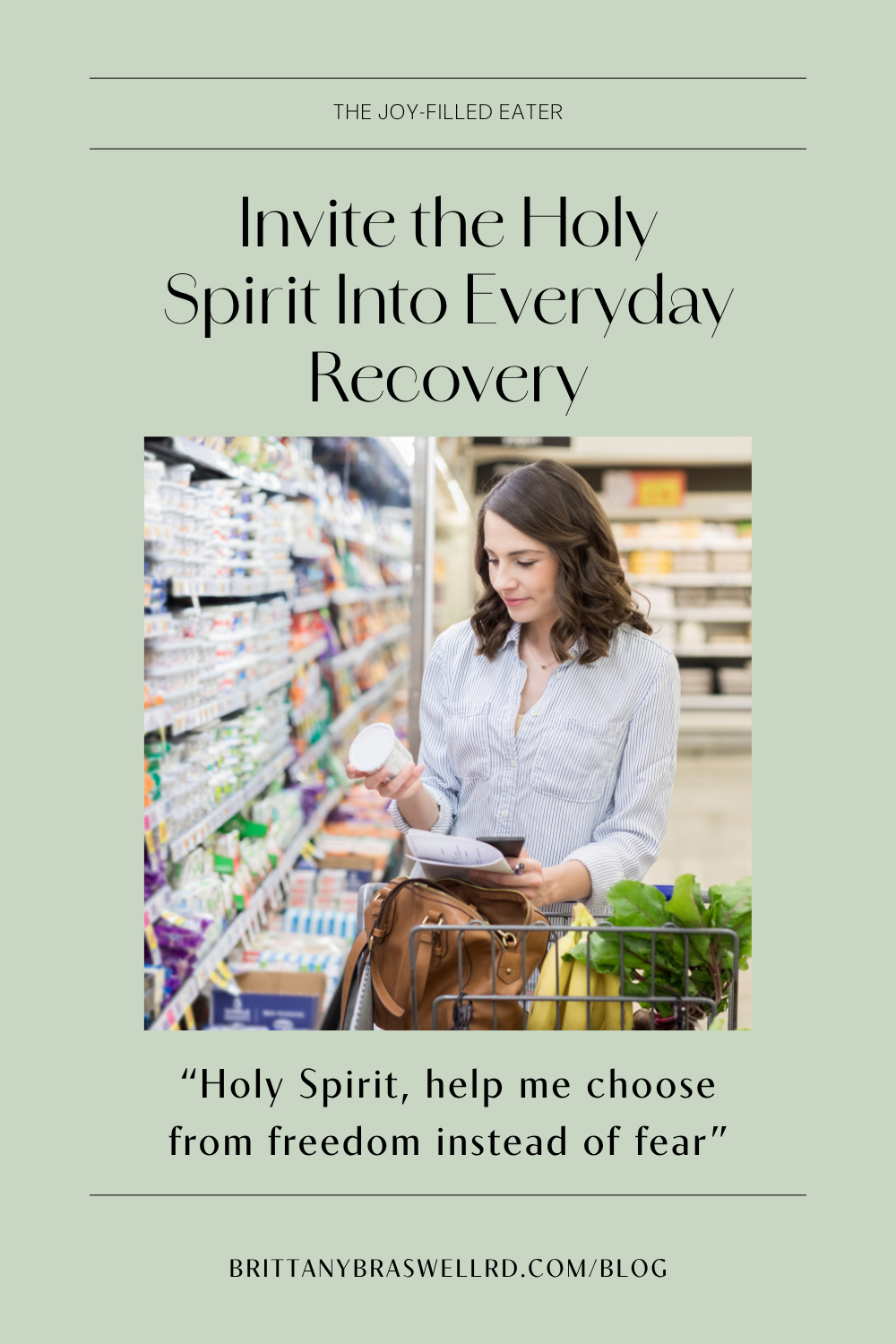
Imagine standing in the yogurt aisle.
Your brain starts racing.
"Should I buy the fat-free one?"
"What if I choose wrong?"
"What if this changes my body?"
Instead of letting anxiety lead...
Pause.
Pray.
Invite God into the decision.
"Holy Spirit, help me choose from freedom instead of fear."
Simple?
Yes.
Powerful?
Absolutely.
Because healing isn't just about making different food choices.
It's about learning dependence instead of self-reliance.
And that changes everything.
Food Freedom and Faith Grow Together
Many women assume they'll focus on their faith after they recover.
But here's what I've seen over and over again.
As women grow in food freedom...
they often grow closer to Jesus too.
Why?
Because every act of recovery is another opportunity to trust Him.
Every food challenge.
Every body image struggle.
Every fear.
Every moment of surrender.
They're all invitations to depend on God more deeply.
Healing isn't just about thinking less about food.
It's about creating more space for Christ.
And friend...
That kind of freedom is worth pursuing.
You Don't Have to Do This Alone
If today's encouragement resonated with you, know this:
There is hope.
You don't have to keep white-knuckling every meal.
You don't have to keep living with constant food noise.
And you certainly don't have to figure recovery out by yourself.
If you're ready to begin breaking free from food obsession while keeping Christ at the center of your healing, I'd love to walk alongside you.
Continue Your Journey
🎧 Subscribe to the Faith-Filled Food Freedom Podcast
💛 Join our free Facebook community for encouragement and support

Final Encouragement
Friend, remember this:
The goal isn't simply to make the eating disorder voice quieter.
The goal is to know God's voice so intimately that the lies become unmistakable.
As you begin identifying your limiting beliefs, rooting your identity in Christ, declaring Scripture over yourself, and inviting the Holy Spirit into everyday moments, something beautiful begins to happen.
The noise starts to lose its power.
The lies become easier to recognize.
And the peace of God becomes easier to hear.
Recovery isn't just about food.
It's about freedom.
And that freedom has been God's heart for you all along.
Stay in touch by subscribing to my personal newsletter, The Full Plate Press
Join over 1000 others and get access to my weekly newsletter with a personal story, BTS sneak peaks, food freedom tips & strategies, riduculous memes, and BONUS goodies from me!
I'm Brittany!
Brittany Braswell, MS, RDN, LD
Host of Faith-Filled Food Freedom & Creator of The Intern Accelerator
I'm here to help Christian women around the world overcome negative body image and an anxiety-ridden relationship with food so they can finally stop stressing and obsessing over how they look and what they eat.