Body Image Struggles for Christian Women: Why a Christ-Centered Approach Leads to True Freedom
There's a particular kind of exhaustion that happens when you love Jesus, want to honor God with your body, and still feel like your reflection has the power to hijack your entire Tuesday.
You can be packing lunches, folding tiny socks, trying to drink your coffee before it goes cold for the third time, and suddenly catch a glimpse of yourself in the hallway mirror.
And there it is.
The thought.
I’ve ruined my body.
Not “I’m having a hard day.”
Not “My body has changed.”
Not “Maybe I need support.”
Just the full-on courtroom verdict, delivered by your inner critic in her little black robe: Guilty. Damaged. Too far gone.
One of my clients, Vicki, knew that thought well.
Before she stepped into food freedom work, she had spent years cycling through diets, weight loss challenges, food rules, and body shame. She wasn’t lazy. She wasn’t careless. She wasn’t “undisciplined.”
She was tired.
Tired of being afraid of sugar.
Tired of feeling like her body was the enemy.
Tired of wondering why Christian faith and food freedom seemed like two puzzle pieces that should fit together, but somehow never had in the spaces she’d been in before.
(🎧 Hear Vicki's full story here in Ep. 136 of Faith-Filled Food Freedom.)
And maybe you know that feeling too.
Maybe you’ve tried to pray your way out of body shame, journal your way out of food guilt, or “just be more disciplined” your way into peace.
Bless it.
Because while prayer matters deeply, and discipline can be a beautiful gift, you cannot shame yourself into freedom. And you definitely cannot diet-culture your way into Christ-centered peace.
Christian women are not immune to cultural beauty standards, body comparison, food fear, or the pressure to appear like we have it all together. In fact, for many women of faith, body image struggles come with an extra layer of guilt.
Because now it’s not just, “Why don’t I like my body?”
It becomes:
- “Am I being vain?”
- “Am I making my body an idol?”
- “Shouldn’t I be more grateful?”
- “If my body is a temple, why do I feel so ashamed of it?”
- “Does wanting peace in my body mean I’m focusing on the wrong thing?”
If your brain has ever sounded like a women’s Bible study, a diet commercial, and your middle school locker room all talking at once, you're not alone.
And friend, you're not crazy either.
There's a way forward that doesn't require obsessing, restricting, performing, or pretending your body image struggles don’t exist.
It’s a Christ-centered approach to food freedom and body peace. And it changes everything.
Why Christian Women Struggle with Body Image Today
Christian women are living in a very loud world.
Social media tells you to age gracefully, but not too naturally.
Wellness culture tells you to nourish your body, but somehow that “nourishment” often comes with a suspicious amount of fear around bread.
Fitness influencers tell you to love your body while also selling you a plan to shrink it.
And sometimes, church culture unintentionally adds another layer by staying silent about bodies unless the conversation is about modesty, self-control, or “temple care.”
That’s a lot of noise for one nervous system to hold.
The struggle for many Christian women isn't simply that the world says, “Your body should look like this.”
It’s that sometimes faith spaces haven't given women a clear, compassionate, biblically grounded way to process what it means to live in a body that changes, ages, hungers, needs rest, takes up space, and refuses to be controlled like a color-coded homeschool planner.
So instead of learning how to relate to our bodies with wisdom and care, many women quietly absorb confusing messages:
- Your body matters, but don’t care too much.
- Health matters, but make sure it looks impressive.
- Discipline is good, but restriction is praised.
- Modesty matters, but your body might be a problem.
- Food is a gift from God, but also maybe something you should constantly monitor.
No wonder so many Christian women feel confused.
And when you add social media to the mix, it gets even messier. Because now you’re not just comparing yourself to celebrities or magazine covers. You’re comparing yourself to the woman from church who meal preps with glass containers, homeschools in linen, runs half marathons, makes sourdough, and somehow has children whose hair is brushed before 9 a.m.
I say this with love: Comparison has never been a spiritual fruit.
And yet, so many women are discipled by comparison more than compassion when it comes to their bodies.
This is why it’s worth asking:
How has your faith shaped what you believe about your body?
Not just what you say you believe.
What you actually believe when your jeans feel tighter.
When the scale goes up.
When a picture gets posted and you immediately zoom in.
When your appetite feels inconvenient.
When your body changes after babies, stress, grief, hormones, aging, or simply being a human person who does not live in a vacuum-sealed Instagram grid.
Your beliefs about your body did not come from nowhere. And healing often begins when you’re brave enough to bring those beliefs into the light.
The Myth: “Good Christian Women Don’t Care About Their Bodies”
Somewhere along the way, a lot of Christian women picked up the idea that caring about body image is shallow.
As if wanting to feel at peace in your body means you are automatically vain, self-absorbed, or spiritually immature.
But that belief does not make you holier. It usually just makes you quieter.
And when body shame gets pushed underground, it rarely disappears. It often comes out sideways through food rules, emotional eating, body checking, avoiding pictures, over-exercising, under-eating, binge eating, or constantly trying to “fix” yourself before you’ll fully show up in your life.
That's not freedom.
God doesn't ask you to pretend your pain is not real in order to prove your faith is strong.
Psalm 139:13-14 says in the ESV:
“For you formed my inward parts;
you knitted me together in my mother’s womb.
I praise you, for I am fearfully and wonderfully made.
Wonderful are your works;
my soul knows it very well."
That passage isn't a decorative throw pillow verse or a Christian wall art meant to be nodded at while you secretly continue treating your body like a before picture.
It's truth.
And if your soul does not know it very well right now, that doesn't mean you're failing. It means that this may be one of the places where God is inviting you into deeper healing.
Because there's a massive difference between saying, “I know God made me,” and actually learning to relate to your body like something God made with care, purpose, and dignity.
For Vicki, one of the heaviest beliefs she carried was the lie that she had ruined her body. Not just changed it or struggled with it. Ruined it.
And when that kind of belief gets lodged deep in your mind and body, a quick pep talk usually won’t touch it.
You need truth, support, and space to untangle what's actually happening underneath the shame.
You need a Christ-centered framework that doesn't just say, “Stop thinking that way,” but gently helps you recognize the lie, bring it into the light, and begin replacing it with what's true.
Because good Christian women do care about their bodies.
- Not because their bodies are idols, but because their bodies are part of their God-given stewardship.
- Not because their appearance defines them, but because body shame can quietly steal their presence, confidence, joy, energy, and obedience.
- Not because they need to look a certain way to be worthy, but because they are already worthy of compassionate care.
The Pressure to Be “Healthy” in All the Wrong Ways
Here’s where things can get sneaky.
Most Christian women who struggle with body image aren't walking around saying, “I'd like to be controlled by diet culture today.”
Duh. That would be too obvious.
Instead, it usually sounds more respectable. Maybe something like:
- “I just want to be healthier.”
- “I need to be a better steward of my body.”
- “I’m cutting that out because it’s inflammatory.”
- “I’m just trying to be disciplined.”
- “I don’t want food to have power over me.”
- “I’m doing this for energy, not weight loss.”
And listen, some of those statements can be completely reasonable.
Wanting more energy isn't wrong, and neither is caring about your health. Making intentional food choices isn't wrong, but the question isn't just, “Is this behavior technically healthy?”
The better question is: “What spirit is driving this?”
Because peace and fear can sometimes do the exact same thing on the outside while producing totally different fruit on the inside.
You can eat a salad from a place of freedom, nourishment, and genuine enjoyment. And you can also eat that exact same salad from panic, punishment, and the belief that you have to “make up for” what you ate last night.
Same salad. Very different story.
And friend, your body knows the difference... and so does your mind... and so does your spiritual life.
Because when “health” becomes another way to control your body, earn approval, avoid shame, or prove your worth, it stops being stewardship and starts becoming a master.
And Jesus was very clear about masters.
Matthew 6:24 says in the ESV:
“No one can serve two masters, for either he will hate the one and love the other, or he will be devoted to the one and despise the other.”
Now, that verse is specifically talking about God and money, so I want to be careful not to rip it out of context and slap it on a smoothie bowl.
But the principle still invites reflection. What has functionally become your master?
The scale?
Your meal plan?
The mirror?
Your Apple watch rings?
The version of your body you're still trying to “get back”?
The approval you imagine you’ll finally feel if you can just become smaller, more toned, more disciplined, or more impressive?
That's where “health” gets spiritually expensive.
Because the pressure to eat perfectly, move perfectly, and look “well” can pull women away from grace and into constant self-monitoring.
You may still be reading your Bible, showing up to church, serving your family, and trying to do all the right things. But internally, food and body thoughts are taking up the best seat in your mind.
They're interrupting your worship, shaping your mood, and influencing your relationships.
They're deciding what events you say yes to, what photos you hide from, what clothes you allow yourself to wear, and how much mental energy you have left to love the people right in front of you.
That is NOT the abundant life Jesus offers.
And it's not the kind of health that actually leads to freedom.
Inside The Joy-Filled Eater Course, this is one of the big shifts we work toward: helping you move from fear-driven “health” to Christ-centered stewardship. Not by giving you another rigid set of rules to obsess over, but by helping you rebuild trust with food, your body, and God’s provision.
Because you don't need another plan that makes your body smaller while your anxiety gets louder.
You need a path that helps your life get freer.
The Common Mistake: Mixing Faith with Diet Culture
One of the most confusing things for Christian women is that diet culture doesn't always show up wearing neon leggings and yelling “summer shred.”
Sometimes it shows up with Scripture references. Other times it shows up in language about obedience, discipline, holiness, self-control, fasting, gluttony, temple care, and “breaking free from food addiction.”
And this is where discernment matters.
Because not everything labeled “biblical” is actually leading you toward biblical freedom. (Yep. I said it.)
Some programs simply take diet culture, tuck a Bible verse into the waistband, and call it discipleship.
But if the core message is still:
Your body is the problem. Your appetite cannot be trusted. Weight loss is evidence of spiritual growth. Restriction is righteousness. Smaller is more disciplined. Food rules are the path to holiness...
Then we have to be willing to ask some hard questions.
Because Christianized diet culture can be even more damaging than regular diet culture.
Regular diet culture may make you feel like you failed a plan, but Christianized diet culture can make you feel like you failed God.
That's a much heavier burden.
And Jesus had some very direct words for heavy burdens.
Matthew 11:28-30 says in the ESV:
“Come to me, all who labor and are heavy laden, and I will give you rest.
Take my yoke upon you, and learn from me, for I am gentle and lowly in heart, and you will find rest for your souls.
For my yoke is easy, and my burden is light.”
If your approach to food, health, and body image consistently produces shame, fear, obsession, isolation, pride, comparison, or despair, it's worth asking whether the burden you're carrying actually came from Jesus.
Because His way may include growth, surrender, uncomfortable honesty, and learning to do hard things, BUT...
- His way does NOT require you to despise your body into submission.
- It DOESN'T ask you to earn love through food performance.
- And it DOESN'T use shame as a shepherd.
This does not mean every conversation about food, movement, or health is automatically diet culture. That would be overly simplistic, and honestly, not very helpful.
But it does mean Christian women need to practice discernment.
Ask questions like:
🤔 Does this teaching increase my trust in God or increase my fear of food?
🤔 Does this approach help me care for my body or push me to control it?
🤔 Does this message root my identity in Christ or in my appearance?
🤔 Does this plan make room for wisdom, flexibility, and compassion?
🤔 Does this lead to freedom, or does it keep me dependent on rules?
Those questions matter.
Because a Christ-centered approach to body image isn't about taking diet culture’s goals and adding prayer.
It's about letting the gospel reshape the entire conversation.
5 Reasons a Christ-Centered Approach Changes Everything
A Christ-centered approach to body image doesn't simply tell you to “love your body” and move on.
That may sound nice on a coffee mug, but if you’ve spent years criticizing, controlling, and comparing your body, you probably need something sturdier than a cute affirmation.
You need truth that holds up when your body changes. Grace that meets you when you feel ashamed. And support that helps you practice freedom in real life, not just think about it during a quiet time.
So here are five reasons a Christ-centered approach changes everything.
1. It replaces shame with grace and unconditional love.
Shame says, “Fix yourself, then come close.”
Jesus says, “Come to me.”
That order matters.
A Christ-centered approach doesn't wait for you to have a perfect relationship with food before you are worthy of care. It starts with the reality that you are already loved, already seen, and already invited into healing.
Grace doesn't excuse harmful patterns. It makes it safe enough to be honest about them. And honesty is where real change begins.
2. It grounds identity in being God’s image-bearer, not a number on the scale.
Your body may change.
Your weight may change.
Your hormones may change.
Your season of life may change.
Your jeans may betray you on a humid day because apparently denim has a flair for drama. 👖
But your identity in Christ does not fluctuate with any of it.
Genesis 1:27 says in the ESV:
“So God created man in his own image, in the image of God he created him; male and female he created them.”
Before you ever had a body image struggle, you had an identity. And that identity was never meant to be negotiated with the mirror.
3. It teaches freedom over fear, especially around food and body changes.
Food freedom doesn't mean you stop caring. It means fear stops being in charge.
This was such a powerful part of Vicki’s story. For years, she felt afraid of sugar and didn't trust herself around it. But through supported, intentional work, she learned that a food like ice cream did not have to hold power over her anymore. Eventually, she could have ice cream in the freezer and forget it was there.
That might sound small if you’ve never felt controlled by a food.
But if you have, you know that's not small at all.
That's freedom showing up in a freezer aisle kind of way. And sometimes, the holiest breakthroughs look very ordinary from the outside.
4. It invites the Holy Spirit into healing, not just habit formation.
A lot of approaches to food and body image focus only on behavior.
Eat this. Track that. Move more. Try harder. Do better.
But Christian body image healing has to go deeper than behavior because the struggle often goes deeper than behavior.
It touches beliefs, fears, wounds, false identities, old stories, and spiritual confusion.
A Christ-centered approach makes room for the Holy Spirit to reveal what's underneath the pattern, not just help you white-knuckle a new routine for three weeks.
Romans 12:2 says in the ESV:
“Do not be conformed to this world, but be transformed by the renewal of your mind, that by testing you may discern what is the will of God, what is good and acceptable and perfect.”
That renewal is not a one-time event. It's a process.
And for many women, food freedom becomes one of the places where God renews their minds in deeply personal, practical ways.
5. It helps women live out their calling with confidence, not comparison.
Body obsession shrinks more than your food choices.
It shrinks your attention.
Your creativity.
Your courage.
Your presence.
Your willingness to be seen.
Your ability to walk into a room and think about the people you’re called to love instead of how your arms look in that shirt.
When body shame is loud, calling often gets quiet.
But as body peace grows, many women find they have more capacity to show up fully in their homes, ministries, work, friendships, and everyday obedience.
Not because they finally achieved the “right” body.
But because their body is no longer the boss of the room.
What Food Freedom and Body Peace Look Like for Christian Women
Food freedom and body peace aren't flashy.
They don't always make for dramatic before-and-after photos.
Honestly, they often look more like a random Tuesday afternoon than a transformation reel.
They look like...
- eating lunch without mentally calculating how to compensate later.
- keeping ice cream in the freezer without it calling your name like a tiny dairy-based dictator.
- going out to dinner and ordering what sounds satisfying without spiraling for three business days.
- putting on clothes that fit your actual body instead of punishing yourself with the ones that only fit a past season.
- talking to yourself with compassion when a picture catches you off guard.
- noticing a body image thought and saying, “That’s not truth. That’s an old story.”
- praying honestly instead of hiding from God because you feel embarrassed that this still bothers you.
- choosing nourishment because your body is worth care, not because your body is on trial.
- and spiritually, they can look like clarity.
Because when food rules and body anxiety stop taking up so much space, you often have more room to listen, serve, enjoy, connect, rest, and respond to what God is actually asking of you in this season.
That's not a small thing.
For Vicki, one of the biggest shifts was realizing she was not alone, not crazy, and not too far gone. She needed a safe space to process the emotions and beliefs that had kept her stuck for years. She also needed support from people who actually understood the complexity of food struggles and body image healing through the lens of faith.
That's why community matters, and it's why support matters.
Because yes, you can keep trying to figure this out alone.
You can keep saving podcast episodes, reading books, praying silently, and promising yourself that next Monday will be different.
But if you're honest, how long has that been the plan, and how much peace has it actually produced in your life?
At some point, growth requires commitment.
It doesn't require perfection, or having every question answered, or feeling totally ready.
It's a humble, faithful willingness to say, “I cannot keep living in this same cycle and calling it normal.”
That's the kind of woman The Joy-Filled Eater Course is designed for.
- The woman who's ready to stop treating food freedom like a someday dream.
- The woman who wants biblical truth, evidence-based support, and practical guidance.
- The woman who's tired of letting body shame narrate her life.
- The woman who knows she needs more than another meal plan.
- The woman who's ready to invest in healing because she understands this is not just about food.
It's about freedom, stewardship, and peace.
It's also about becoming the kind of woman who can nourish her body, renew her mind, and follow Jesus without dragging food fear and body shame into every room.
Ready to stop fighting your body and start walking in Christ-centered food freedom? Join The Joy-Filled Eater Course HERE ⬇️
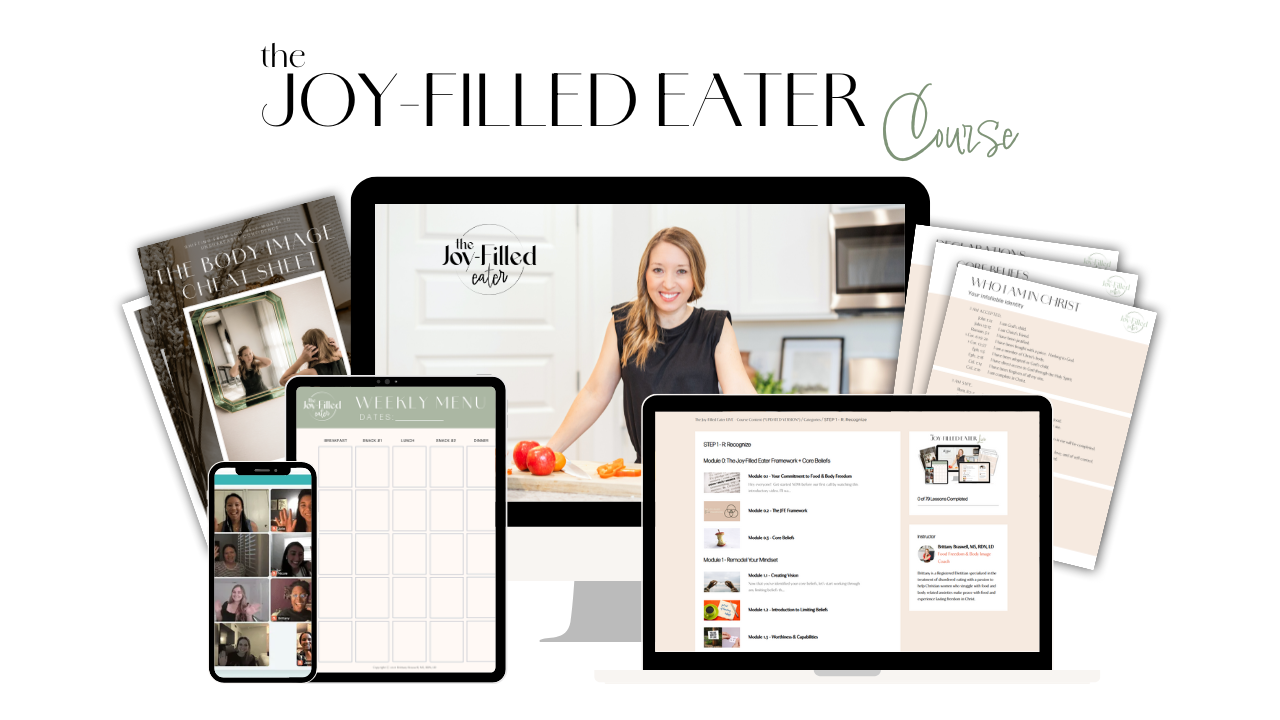
Frequently Asked Questions
Can I care about my health and still reject diet culture?
Yes. Absolutely!
Rejecting diet culture doesn't mean rejecting health. It means rejecting the belief that your worth, morality, discipline, or spiritual maturity are determined by your weight, appearance, food choices, or ability to control your body.
You can care about your health in a Christ-centered way. You can nourish your body and move it in a joyful way.
You can honor your hunger and fullness and make intentional choices while also pursuing strength, improved energy levels, and greater overall wellness.
But the heart posture matters.
Health rooted in fear will keep you anxious, and health rooted in shame will keep you striving.
But health rooted in Christ-centered stewardship can become peaceful, flexible, and life-giving.
What if my church reinforces body shame or unrealistic standards?
First, I am so sorry if a place that should have pointed you toward freedom has instead made your body feel like a problem.
Sometimes body shame is reinforced directly through comments, teachings, or weight-focused programs. Other times it happens more subtly through silence, appearance-based praise, modesty messages that place too much responsibility on women’s bodies, or “health” conversations that sound a lot like diet culture with a devotional attached.
You're allowed to use discernment and to grieve what was harmful.
You're also allowed to seek support outside of that specific environment while still loving Jesus and loving the Church.
And you're also allowed to ask questions like, “Is this message producing the fruit of the Spirit in me, or is it producing fear, shame, comparison, and control?”
Galatians 5:22-23 says in the ESV:
“But the fruit of the Spirit is love, joy, peace, patience, kindness, goodness, faithfulness,
gentleness, self-control; against such things there is no law.”
A body image approach that is truly led by the Spirit will not be marked by constant panic and self-hatred.
Is it selfish to want to feel good in my body?
No way, Jose!
Wanting peace in your body is NOT selfish.
Wanting to stop obsessing over food is NOT selfish.
Wanting to enjoy meals with your family without guilt is NOT selfish.
Wanting to get dressed without a shame spiral is NOT selfish.
Wanting mental freedom so you can be more present with God and the people He has entrusted to you is not selfish.
It's stewardship.
Now, can body goals become selfish or consuming? Of course. Anything can become disordered when it takes the place of God. But that doesn't mean every desire for body peace is automatically an idol.
Sometimes the desire to feel good in your body is actually a desire to stop living under condemnation.
Romans 8:1 says in the ESV:
“There is therefore now no condemnation for those who are in Christ Jesus.”
That includes the body image spiral you had this morning, the food guilt from last night, those old jeans, the changing body, the complicated history, and the part of you that feels embarrassed this is still hard.
How do I know if I’ve made my body an idol—or if I’m just struggling?
This is SUCH an important question, and it deserves compassion, not a quick accusation.
A helpful place to start is to look at fruit & function.
Ask yourself:
- How much mental space does my body take up each day?
- Do my food choices determine my mood, confidence, or sense of worth?
- Am I avoiding parts of my life until my body changes?
- Do I believe I would be more lovable, valuable, or useful to God in a different body?
- Does pursuing body change consistently pull me away from peace, presence, and obedience?
If your body has become an idol, the invitation isn't to shame yourself harder. It's to return to the Lord with honesty.
If you're struggling, the invitation isn't to dismiss it. It's to receive support.
Either way, condemnation will not heal you. Christ will.
And sometimes Christ’s care comes through wise counsel, safe community, evidence-based teaching, and a faithful next step you have been putting off because part of you hoped this would just magically disappear on its own.
Friend, I say this with love: You do not have to wait until things are “bad enough” to get help.
If body image anxiety and food guilt are stealing your peace, that matters now.
Final Thoughts: Your Body Was Never the Problem
Your body was never the problem.
Not when it changed.
Not when it aged.
Not when it carried babies.
Not when it gained weight.
Not when it needed rest.
Not when it felt hunger.
Not when it failed to match the version of you that diet culture promised would finally make life easier.
And your body's not an apology.
It's not a project to perfect before you can live freely or proof that you failed. It's part of God’s good design, worthy of care, compassion, and truth.
And yes, learning to believe that may take time. It may feel uncomfortable at first and require support, practice, and a willingness to confront some old beliefs that have been running the show for far too long.
But freedom IS possible.
Not because you finally become disciplined enough to control every bite or because your body finally becomes acceptable by the world’s standards. And not because you learn to silence every insecure thought forever.
Freedom is possible because Christ is not intimidated by your struggle.
He's not disappointed that body image is hard for you or standing at a distance waiting for you to get it together.
He invites you into truth, grace, renewal, and a better way of living in the body He gave you.
Galatians 5:1 says in the ESV:
“For freedom Christ has set us free; stand firm therefore, and do not submit again to a yoke of slavery.”
That includes the yoke of body shame, of food fears, of comparison, and of trying to earn peace through control.
So if you're tired of making your body the battleground, tired of treating food like a moral test, and tired of wondering if lasting food freedom is actually possible for someone like you, I want to invite you to take your next step.
Inside The Joy-Filled Eater Course, I’ll help you begin untangling food guilt, body image anxiety, and diet-culture confusion through a Christ-centered, compassionate, practical approach.

You’ll learn how to stop seeing food as good or bad, rebuild trust with your body, renew your mind with biblical truth, and move toward lasting food freedom without obsessing, restricting, or trying to DIY your way through one more cycle.
This is for the woman who's ready to stop “starting over Monday” and start walking in freedom today.
And if you’re not quite ready for the course yet, I’d love to have you hang out with me on my podcast, Faith-Filled Food Freedom.
🍎 Subscribe to the show on Apple Podcasts
Because you do not have to do this alone.
You're not crazy, you're not too far gone, and your body was never (and will never be) the problem.

Stay in touch by subscribing to my personal newsletter, The Full Plate Press
Join over 1000 others and get access to my weekly newsletter with a personal story, BTS sneak peaks, food freedom tips & strategies, riduculous memes, and BONUS goodies from me!
I'm Brittany!

Brittany Braswell, MS, RDN, LD
Host of Faith-Filled Food Freedom & Creator of The Intern Accelerator
I'm here to help Christian women around the world overcome negative body image and an anxiety-ridden relationship with food so they can finally stop stressing and obsessing over how they look and what they eat.