Navigating Body Grief Finding Healing and Hope as a Christian Woman

Lauren sat across from me with tears in her eyes and said something I’ve heard in different versions more times than I can count:
“I know I’m healthier now. I know this is better. But I still miss my old body.”
And then, almost immediately, she apologized.
Because that’s what so many Christian women do when grief touches their body. They apologize for it. They explain it away. They try to make it sound more “spiritual,” more grateful, more acceptable, less messy.
Lauren had been doing hard, holy, brave work in her recovery from disordered eating. She was eating more consistently. She was no longer organizing her entire life around the size of her body. Her thoughts around food were quieter. Her energy was better. Her relationships were less strained. Her body was more stable.
And yet, there was still grief.
Not because she wanted to go back to the behaviors that had harmed her. Not because she didn’t trust God. Not because she was vain, shallow, ungrateful, or “just struggling with insecurity.”
She was grieving the body size she had when she was deepest in her eating disorder.
The body that got compliments and that felt socially acceptable.
The body that made her feel like she finally had some sort of control.
The body that was never actually free.
And friend, that is complicated grief.
It is not the kind of grief people usually bring a casserole for. Nobody starts a meal train because your jeans fit differently after recovery, pregnancy, illness, perimenopause, stress, aging, medication, or a hard season of life.
But that doesn't make the grief less real.
Body grief is the emotional response to changes in how your body looks, feels, or functions. And for many Christian women, it's one of the most unspoken pieces of body image healing.
You may be grieving the body you had before kids, before chronic stress took over, before an injury. The body you had before your hormones started acting like they joined a group chat and nobody told you the rules.
Or maybe, like Lauren, you're grieving the body you had when your relationship with food was anything but peaceful.
And if that feels confusing, tender, or even a little embarrassing to admit, I want you to hear me clearly:
You can grieve your body and still be growing in faith.
You can feel sadness and still be thankful.
You can miss what was and still choose healing.
You can bring your grief to Jesus without cleaning it up first.
What Is Body Grief and Why Does It Hurt So Deeply?
Body grief isn't “just bad body image.”
It's not simply having a hard day in the dressing room (although mercy, those fluorescent lights have personally never led anyone closer to spiritual maturity).
Body grief goes deeper.
It's the ache that shows up when your body no longer feels familiar. It's the sadness that rises when your body changes in a way you did not choose, did not expect, or did not feel ready for. It's the quiet mourning of what your body used to be able to do, how it used to look, or how you used to feel inside of it.
And because our culture has done a bang-up job of tying a woman’s worth to her appearance, body grief often feels like more than physical change.
It can feel like losing:
- A sense of identity
- A feeling of control
- The approval of others
- Confidence in social settings
- The body you thought you were “supposed” to have
- The illusion that if your body looked a certain way, life would finally feel easier
This is why body grief can hurt so deeply. Because you're not only grieving a clothing size, a number on the scale, a diagnosis, a physical limitation, or a reflection in the mirror.
Often, you're grieving the story you attached to that body.
The story that said, “If I can get back there, I’ll feel like myself again.”
The story that said, “If my body changes, people will think I’ve let myself go.”
The story that said, “If I accept this body, I’m giving up.”
The story that said, “If I don’t fight my body, I won’t be a good steward of it.”
And that last one is where a lot of Christian women get stuck.
Because when body grief gets tangled up with faith, it can start to sound spiritual while still being deeply shame-based.
You may tell yourself, “I should be taking better care of my temple,” when what you really mean is, “I’m afraid my body is unacceptable.”
You may tell yourself, “I just want to be healthy,” when underneath that is a fear of being seen, judged, or dismissed.
You may tell yourself, “I need more discipline,” when what your heart actually needs is compassion, support, and truth.
Body grief can show up after:
- Pregnancy or postpartum body changes
- Perimenopause or menopause
- Weight gain during eating disorder recovery
- Chronic illness or autoimmune conditions
- Injury or physical limitations
- Aging and visible body changes
- Stressful life seasons that change your routines, appetite, energy, or body composition
And yes, it can also show up when you've spent years trying to control your body through dieting, only to realize the version of yourself you were chasing came with a cost you can no longer afford.
A cost to your peace, your presence, your relationship with food, and your ability to show up fully in the life God has given you.
So before we rush to fix it, reframe it, or slap a Bible verse on top of it like a spiritual sticker, we have to be willing to tell the truth.
Body grief hurts because your body has never just been a body to you.
It's been wrapped in identity, belonging, safety, beauty, acceptance, control, and for many women, a long history of trying to be “enough.”
The Myth: “I Should Just Be Grateful for My Health”
One of the most common things I hear from Christian women navigating body grief is this: “I know I should just be grateful.”
And listen, gratitude is beautiful. It's biblical, and it matters.
But gratitude was never meant to become a muzzle.
You're allowed to be thankful for what your body can do and still feel sadness about what has changed.
You're allowed to praise God for healing and still grieve what the healing process has required of you.
You're allowed to appreciate your health and still feel disoriented in a body that feels unfamiliar.
Gratitude and grief are not enemies. They can sit at the same table.

The Psalms show us this over and over again. Scripture does not present emotional honesty as a lack of faith. In fact, biblical lament often brings pain directly to God instead of pretending it does not exist.
Psalm 13:1-2 says:
“How long, O LORD? Will you forget me forever? How long will you hide your face from me? How long must I take counsel in my soul and have sorrow in my heart all the day? How long shall my enemy be exalted over me?”
That's not polished. It's not wrapped in a cute bow or the kind of thing you embroider on a throw pillow for the church lobby.
And yet, it's Scripture.
God included words of sorrow, confusion, and longing in His Word because He is not threatened by your honest emotions.
Lamentations 3:22-24 says:
“The steadfast love of the LORD never ceases; his mercies never come to an end; they are new every morning; great is your faithfulness. ‘The LORD is my portion,’ says my soul, ‘therefore I will hope in him.’”
But do you know what comes before that beautiful declaration of hope?
A whole lot of grief.
Lament does not skip sorrow to get to hope faster. It brings sorrow into the presence of God so hope can be formed in truth, not denial.
And when we look at Jesus, we don't see Him shaming people for suffering. We see Him moving toward them.
He touched the sick. He wept with the grieving. He restored dignity to the ashamed. He asked questions that invited honesty. He did not rush people into a prettier emotional state so everyone else would feel more comfortable.
So if you've been telling yourself, “I should just be grateful,” maybe the more honest sentence is:
“I can be grateful and still need space to grieve.”
That's not spiritual weakness. It's emotional maturity.
How Body Grief Intersects with Identity and Faith
Body image is rarely just about appearance.
For so many women, body image is connected to womanhood, desirability, discipline, social belonging, motherhood, aging, health, and even perceived spiritual maturity.
That's why body grief can feel so destabilizing.
When your body changes, it can feel like you changed.
When it doesn't look the way you hoped, it can feel like you failed.
When it no longer matches the version of yourself you were praised for, it can feel like your worth is up for debate.
But that's where we have to come back to what is true.
Your body is not the scoreboard of your worth, spiritual résumé, or the most important thing about you.
And your body is absolutely not an ornament God gave you to keep culturally acceptable.
Your body is a vessel through which you live, love, serve, worship, hug your people, laugh until you cry, walk through hard seasons, and show up for the life God has placed in front of you.
That doesn't mean your body doesn't matter.
It means your body matters without being the measure of your value.
1 Corinthians 6:19-20 says:
“Or do you not know that your body is a temple of the Holy Spirit within you, whom you have from God? You are not your own, for you were bought with a price. So glorify God in your body.”
For years, many women have heard this verse used almost exclusively as a warning against eating certain foods or gaining weight. But that interpretation is far too small.
Glorifying God in your body isn't about manipulating your body into a culturally celebrated shape.
It 's about honoring God with the body you have. Feeding it. Resting it. Caring for it. Listening to it. Using it to love others. Refusing to punish it into submission. Refusing to make it an idol. Refusing to make it your enemy.
Romans 12:2 says:
“Do not be conformed to this world, but be transformed by the renewal of your mind, that by testing you may discern what is the will of God, what is good and acceptable and perfect.”
And friend, if there were ever an area where Christian women need to stop being conformed to the world, body image is absolutely on the list.
Because the world will tell you:
- Your body is a project.
- Your weight determines your discipline.
- Your aging body is a problem to solve.
- Your postpartum body needs to “bounce back.”
- Your recovered body is less acceptable than your restricted one.
But God doesn't call you beloved because of your measurements.
Ephesians 1:4-5 says:
“Even as he chose us in him before the foundation of the world, that we should be holy and blameless before him. In love he predestined us for adoption to himself as sons through Jesus Christ, according to the purpose of his will.”
Before you had a body image struggle, before you ever went on a diet, before you ever compared yourself to another woman, before you ever stood in front of a mirror and mentally picked yourself apart, God’s love was already set on you in Christ.
That's where identity has to be anchored.
Not in your appearance. Not in your “before” body. Not in how well you follow food rules. Not in whether your body makes other people comfortable.
In Christ.
And that truth isn't just something to nod at during a quiet time. It 's something you learn to bring into the dressing room, the doctor’s office, the family gathering, the summer pool day, the photo someone tagged you in without your consent, and the Tuesday morning when your jeans are being emotionally unsupportive.
The Common Mistake: Rushing the Healing Process
Here's where so many women accidentally stay stuck:
They try to heal body grief by rushing past it.
They tell themselves:
🗣️ “I shouldn’t feel this way.”
🗣️ “Other people have it worse.”
🗣️ “I just need to pray more.”
🗣️ “I should be over this by now.”
🗣️ “If I really trusted God, this wouldn’t bother me.”
But minimizing grief doesn't make it disappear.
It usually just sends it underground, where it quietly fuels anxiety, resentment, comparison, food rules, body checking, and the constant urge to “fix” yourself.
Lauren was living proof of this.
For a while, she kept trying to talk herself out of the grief. She knew her recovered body was healthier. She knew her relationship with food was better. She knew she had more freedom.
But she still felt sadness.
And because she kept judging the sadness, she couldn't actually move through it.
Once she gave herself permission to name what she had lost, what she feared, and what she was still believing about acceptance, the grief started to loosen its grip.
Not overnight or in a glittery montage with inspirational music.
But slowly, honestly, and with support.
This matters because body grief is not healed by pretending you are fine.
And it's not healed by spiritual bypassing either.
Spiritual bypassing is when we use spiritual language to avoid emotional honesty. It can sound like:
- “Just pray about it.”
- “Just be thankful.”
- “Just remember your body is temporary.”
- “Just focus on Jesus and stop thinking about it.”
Now, should we pray? Absolutely. Should we practice gratitude? Yes. Should we remember eternal truth? Of course.
But when those phrases are used to shut down grief instead of bring grief to God, they can unintentionally cause more harm.
Healing requires space.
It requires compassion.
It requires telling the truth without letting the truth spiral into self-pity.
There's a difference between honoring grief and idolizing grief.
✅ Honoring grief might look like saying, “Lord, I feel sad that my body has changed, and I need Your help to understand what this sadness is revealing.”
❌ Idolizing grief might look like rehearsing the same shame story every day and refusing support because the grief has become part of your identity.
✅ Honoring grief might look like talking with a trusted dietitian, therapist, mentor, or coach who can help you process what is underneath the body distress.
❌ Idolizing grief might look like using your pain as proof that freedom is impossible.
✅ Honoring grief is honest.
❌ Idolizing grief keeps you trapped.
And this is one reason I created The Joy-Filled Eater Course.
Because most women don't need another random body positivity pep talk from the internet. They need a clear, Christ-centered path for understanding what is happening beneath their food and body struggles, renewing their minds with truth, and learning how to respond differently when shame gets loud.
Ready to stop rushing past your body grief & food guilt and start truly healing your body image?
Join me inside The Joy-Filled Eater Course HERE 👈🏼.

5 Steps to Move Through Body Grief with Faith and Grace
I’m going to give you five steps here, but I want to be very clear: this is NOT a quick-fix checklist.
It isn't “five easy steps to love your body by Friday,” because that would be suspicious, and also I would like us to keep our expectations somewhere in the neighborhood of reality.
These steps are however, a starting point.
They can help you understand what needs to happen and why it matters as you begin moving through body grief with faith and grace.
1. Name the grief
You cannot heal what you keep pretending is not there.
Start by naming what you're grieving.
Maybe you're grieving ease. Maybe you're grieving energy. Maybe you're grieving the way clothes used to fit. Maybe it's the version of yourself who felt more confident, even if that confidence was built on control.
You might journal, pray out loud, talk with a trusted friend, or simply say, “God, I feel grief about my body, and I don't know what to do with it yet.”
That kind of honesty can be a holy beginning.
2. Renew your mind with truth
Body grief often comes with deeply practiced thought patterns.
Thoughts like:
“I’m less lovable now.”
“I’ll never feel confident again.”
“People are judging me.”
“My body is proof that I failed.”
Those thoughts don't change simply because you tell yourself to “stop thinking that way.”
They change as your mind is renewed with truth over time.
Romans 12:2 reminds us:
“Do not be conformed to this world, but be transformed by the renewal of your mind, that by testing you may discern what is the will of God, what is good and acceptable and perfect.”
Renewal is not a one-time pep talk. It's a practice.
And for many women, it's a skill that needs to be learned with guidance, repetition, and support.
3. Practice embodied gratitude
Embodied gratitude means learning to appreciate your body for more than just how it looks.
This doesn't mean forcing yourself to love every body part. It might look like expanding your view.
Your arms let you hold your child.
Your legs carry you through your day.
Your stomach digests food and helps nourish you.
Your face expresses joy, concern, laughter, and love.
Your body isn't merely something to evaluate.
It's someone you live in.
And when you begin practicing gratitude for function, presence, and capacity, you start loosening the grip of appearance-based worth.
4. Set boundaries with body image triggers
Some environments make body grief louder.
That doesn't mean you're weak. It means you're human.
If certain social media accounts, conversations, fitness spaces, family comments, or wellness content consistently stir up shame, comparison, or panic, it may be time for boundaries.
A boundary might sound like:
- “I’m not discussing weight or dieting at family meals.”
- “I’m unfollowing accounts that make me feel like my body is a problem to solve.”
- “I’m taking a break from body-checking photos.”
- “I’m choosing movement that supports my body instead of punishing it.”
Boundaries are not dramatic. They're stewardship.
They help protect the healing God is doing in you.
5. Seek spiritual and professional support
Body grief can feel lonely, especially when people around you don't understand why your body changes feel so emotionally loaded.
But you were not created to heal in isolation.
Support might include faith-based therapy, mentorship, pastoral care, dietitian support, or a Christ-centered course that helps you address food and body struggles with both compassion and clarity.
This is also why I’d love to invite you into my free Facebook community, Food Freedom & Body Image Support for Christian Women, where you can be reminded that you are not the only one navigating this.
And if you're ready for more structured support, The Joy-Filled Eater Course was created to help you stop letting food fear and body shame run the show, so you can build lasting food freedom with practical tools and Christ-centered truth.
What Healing Can Look Like on the Other Side of Body Grief
Healing body grief doesn't always mean you wake up one morning, look in the mirror, and think, “Wow, obsessed.” 🪞😏
(That would be lovely, of course. We would all enjoy a little main-character mirror moment.)
But real healing is often quieter than that.
Healing may look like getting dressed without spiraling.
Eating breakfast even when your body image feels shaky.
Going to the pool with your kids and staying present instead of mentally editing your body the whole time.
It may look like deleting the photo and then realizing you don't need to punish yourself for how you looked in it.
It may look like noticing a body change and responding with care instead of panic.
Or it may look like saying, “I don’t love this, but I also don’t have to hate myself through it.”
That's freedom. Not perfection. FREEDOM.
I've seen women come to a place where they can accept, care for, and even celebrate bodies they once resented. Not because every insecurity vanished, but because their identity became less fragile.
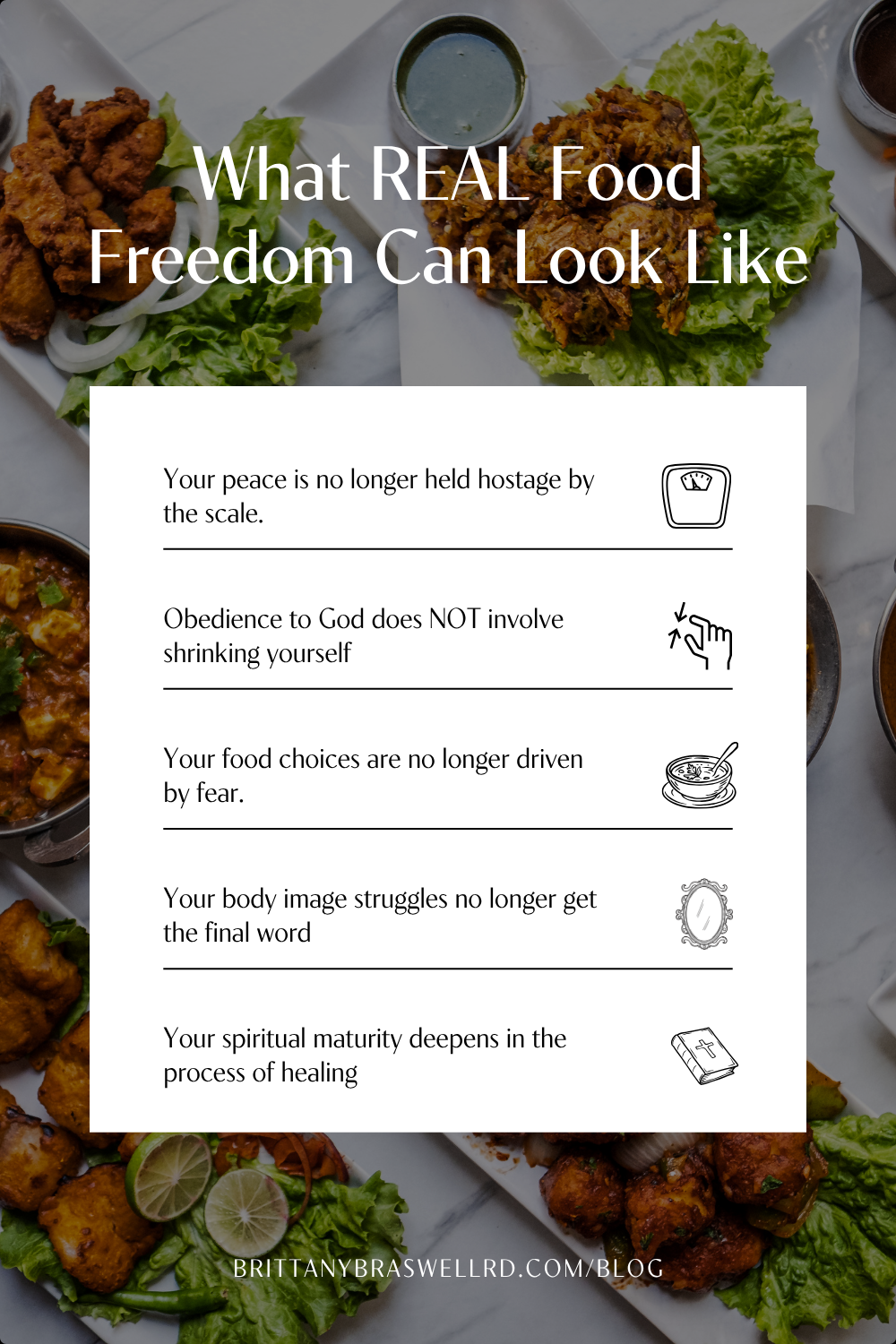
Their peace was no longer held hostage by the scale.
Their obedience to God was no longer confused with shrinking themselves.
Their food choices were no longer driven by fear.
Their body image struggles no longer got the final word.
And often, their spiritual maturity deepened in the process.
Because body grief has a way of revealing what we've been trusting in.
Approval
Control.
Thinness.
Youth.
Comfort.
Certainty.
And when those things start to feel shaky, we're invited back to the One who never is.
Healing doesn't always mean liking your body.
Sometimes healing means making peace with your body, choosing to care for your body before you feel confident in it, grieving what changed while still refusing to abandon yourself, and sometimes healing means finally admitting, “I don't want to spend the next ten years fighting the body God has entrusted to me.”
That admission can become a turning point.
Frequently Asked Questions
Can I grieve my body and still trust God’s plan for it?
Yes.
Grief and trust can coexist.
Trusting God doesn't mean you never feel sadness, confusion, or disappointment. It means you bring those emotions to Him instead of carrying them alone or letting them become the lens through which you see yourself.
Jesus Himself modeled sorrow without sin. He wept. He lamented. He experienced anguish. Emotional honesty is not a lack of faith.
You can say, “Lord, I trust You,” and also say, “This feels hard.”
Both can be true.
What if I’ve never felt at home in my body?
Then body grief may not be about losing a body you loved.
It may be about grieving the fact that your body has never felt like a safe or peaceful place to live.
And that's just as impactful.
If you've spent years feeling uncomfortable, ashamed, or disconnected from your body, healing may begin with compassion instead of pressure. You don't have to leap into body love.
Start with body respect, consistent nourishment, noticing how your body feels, telling the truth about what you've experienced, and inviting God into that tender place.
And please know this: feeling disconnected from your body does not mean you're broken beyond repair. It means there's a place in you that needs care, safety, and support.
How do I talk about body grief with other Christians who don’t understand?
Gently and wisely.
Not everyone has earned access to the tender parts of your story.
You might say something simple like, “I’m working through some grief around body changes, and I’m learning how to care for my body without shame.”
If someone responds with a quick fix, diet advice, or a spiritual cliché, you don't have to keep explaining yourself.
You can say, “I appreciate your concern, but I’m not looking for body or weight advice right now.”
Or, “This is something I’m processing through with trusted support.”
Sometimes the most effective thing you can do is stop bringing vulnerable things to people who consistently mishandle them.
Is it okay to still want to change my body while grieving it?
This is a tender question, and the answer requires honesty.
It's not automatically wrong to desire physical change, but it is important to ask what's driving that desire.
Is it care or control?
Is it stewardship or shame?
Is it rooted in health, peace, and wisdom, or is it rooted in fear, comparison, and the belief that you cannot be okay unless your body changes?
You don't have to shame yourself for wanting change.
But you also don't have to obey every urge to fix your body in order to feel acceptable.
A Christ-centered approach to food freedom and body image healing helps you discern the difference, and that discernment is a skill worth developing.
Final Thoughts: God Meets You in the Grief and the Healing
If body grief has been sitting quietly under the surface for you, I hope this gives you language for what you have been carrying.
You're not crazy, shallow, or failing as a Christian because your body changes have affected you emotionally.
You're human.
And you're invited to bring all of it to God.
Not the cleaned-up version.
Not the version that already has the right answer.
Not the version that can quote the verse while secretly spiraling in the bathroom.
The real version.
The woman who's tired of fighting her body.
Who misses who she used to be.
Who knows dieting isn't the answer anymore but still feels scared to stop chasing control.
The woman who wants to trust God with her body but honestly doesn't know what that looks like in everyday life.
Isaiah 61:3 says that the Lord gives:
“to grant to those who mourn in Zion—to give them a beautiful headdress instead of ashes, the oil of gladness instead of mourning, the garment of praise instead of a faint spirit; that they may be called oaks of righteousness, the planting of the LORD, that he may be glorified.”
The Lord isn't asking you to pretend there are no ashes. He meets you in them.
And He's able to bring beauty, gladness, strength, and rootedness in places you thought would only ever hold shame.
If you're ready to stop rushing past your body grief and start learning how to process it in a way that leads to actual healing, I’d love to invite you into The Joy-Filled Eater Course.
Inside this evidence-based, Christ-centered program, you’ll learn how to renew your mind, rebuild body trust, release food guilt, and pursue lasting food freedom through a Christ-centered lens.
Not by obsessing harder, shrinking yourself into acceptability, or pretending grief isn't there.
But by learning how to bring your whole self—body, mind, emotions, and faith—into the healing process.
Because peace with food and your body is 100% possible.
Stay in touch by subscribing to my personal newsletter, The Full Plate Press
Join over 1000 others and get access to my weekly newsletter with a personal story, BTS sneak peaks, food freedom tips & strategies, riduculous memes, and BONUS goodies from me!
I'm Brittany!

Brittany Braswell, MS, RDN, LD
Host of Faith-Filled Food Freedom & Creator of The Intern Accelerator
I'm here to help Christian women around the world overcome negative body image and an anxiety-ridden relationship with food so they can finally stop stressing and obsessing over how they look and what they eat.