Why Overwhelm Fuels Food Anxiety (And a Simple 30-Second Reset to Help You Find Peace)
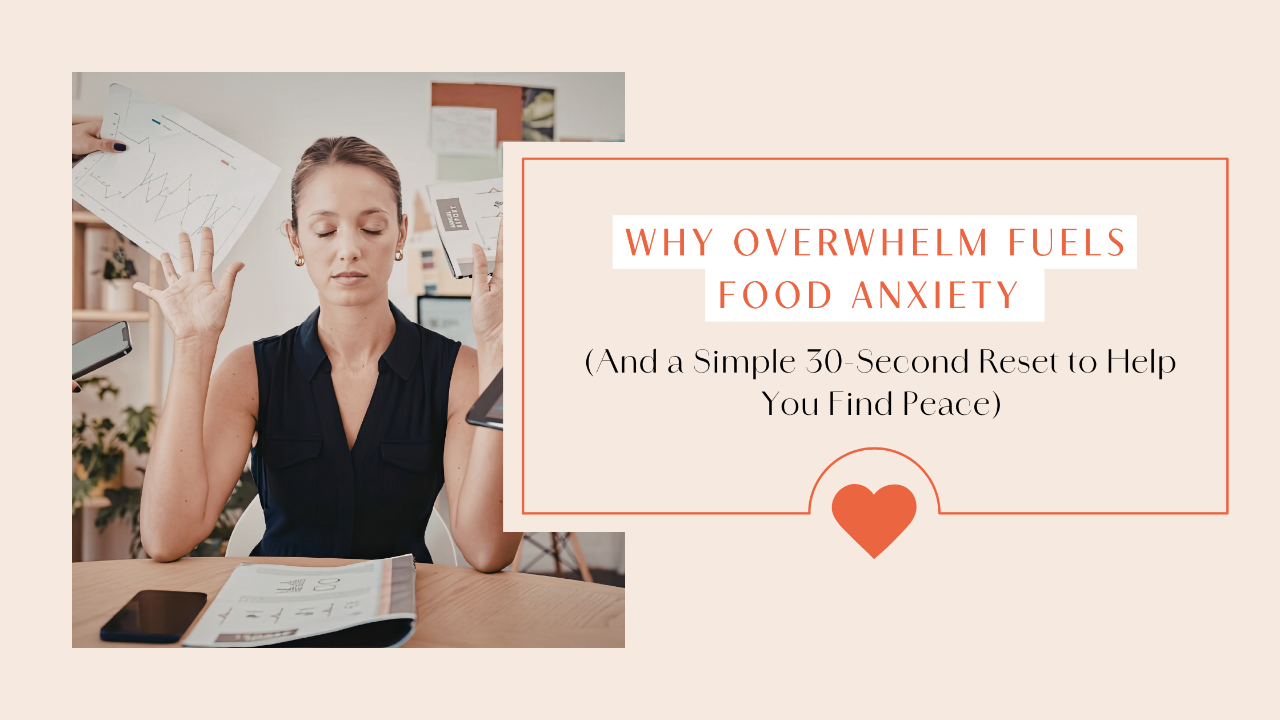
Have you ever noticed that the more overwhelmed you feel, the louder the food thoughts become?
You know the feeling.
- Your calendar is packed.
- The kids need something.
- The laundry mountain has somehow become sentient.
- Your inbox is overflowing.
- And before you know it, you're standing in the pantry wondering why all you can think about is food.
Or maybe the opposite happens.
Instead of feeling drawn toward food, you find yourself obsessing over what you should eat, what you shouldn't eat, how much exercise you need to do tomorrow, or whether your jeans feel tighter than they did yesterday.
Sound familiar?
If you've ever felt like your food anxiety gets worse during busy, stressful seasons, friend, you're not imagining it.
And more importantly?
It's not because you lack willpower.
It's not because you're "doing food freedom wrong."
And it's definitely not because you're failing.
The truth is that overwhelm and food anxiety are deeply connected. In fact, overwhelm may be one of the biggest hidden drivers behind the food thoughts, body checking, cravings, guilt, and anxiety you've been struggling with.
Let's talk about why.
Why Overwhelm Makes Food Anxiety Worse
For many women, life can feel like trying to juggle flaming bowling pins while balancing on a unicycle.
Impressive? Maybe.
Peaceful? Not exactly.
Between work responsibilities, family commitments, school activities, household tasks, appointments, and the pressure to keep everything running smoothly, it's no wonder so many women end up feeling emotionally exhausted.
And here's where things get interesting.
When overwhelm increases, food anxiety often follows right behind it.
That's because overwhelm doesn't just affect your emotions.
It affects your nervous system.
Your Brain Thinks You're in Survival Mode
When your schedule is overloaded, your mind is racing, and your stress levels are through the roof, your nervous system can begin interpreting your environment as unsafe.
Now, to be clear, I'm not saying your brain literally thinks a plate of cookies is chasing you down the street.
But your body does begin responding as though there's a threat that requires heightened attention.
When that happens, your brain shifts into what we often call "survival mode."
And survival mode changes everything.
Suddenly:
- Food feels louder.
- Cravings feel more intense.
- Restrictive urges become stronger.
- Body checking increases.
- Guilt around eating becomes more frequent.
- Food thoughts seem impossible to turn off.
If you've ever wondered, "Why can I stop thinking about food right now?" the answer may not be the food itself.
It may be the overwhelm.
The Connection Between Overwhelm and Food Thoughts
One of the most important things I want you to hear is this:
Your overwhelm is driving your food anxiety.
Not a lack of discipline.
Not a lack of willpower.
Not because you're weak.
Not because you've somehow failed at food freedom.
This is physiology.
When your nervous system is activated, your thoughts become louder.
Your emotions become more intense.
Your brain becomes hypervigilant.
And because food has likely been tied to control, comfort, safety, achievement, or self-worth at various points in your life, it often becomes one of the first places your brain directs its attention.
Think of it like this:
Imagine your nervous system is a smoke detector.
When it's working properly, it alerts you when there's an actual fire.
But when overwhelm takes over, it's like that smoke detector becomes overly sensitive.
Now it's going off because someone burned toast.
Every little thing feels urgent.
Every food decision feels bigger.
Every craving feels more significant.
Every body image concern feels more important than it actually is.
Oy vey.
No wonder you're exhausted.
Why Food Anxiety Isn't Really About Food
This is one of the biggest mindset shifts I teach inside my work with Christian women.
Often, what looks like a food problem is actually a stress problem.
Or an overwhelm problem.
Or a nervous system problem.
When life feels chaotic, our brains naturally search for something they can control.
And for many women who have spent years trapped in diet culture, food becomes the easiest target.
So instead of addressing the overwhelm itself, we start:
- Counting calories
- Tracking macros
- Planning stricter eating rules
- Body checking more frequently
- Weighing ourselves more often
- Obsessing over "good" foods versus "bad" foods
But none of those behaviors actually solve the underlying problem.
Because the real issue wasn't the food.
The real issue was that your nervous system was waving a giant white flag saying:
"Hey friend, I need support."
A Simple 30-Second Reset for Food Anxiety
The good news?
You don't need an hour-long morning routine.
You don't need a perfectly organized planner.
You don't need to escape to a remote cabin in the mountains.
(Although if someone wants to bring me coffee on a quiet mountain porch, I wouldn't complain.)
What you need is a simple way to interrupt the spiral before it gains momentum.
That's why I love this 30-second reset strategy.
When you notice overwhelm starting to rise, walk through these four simple steps:
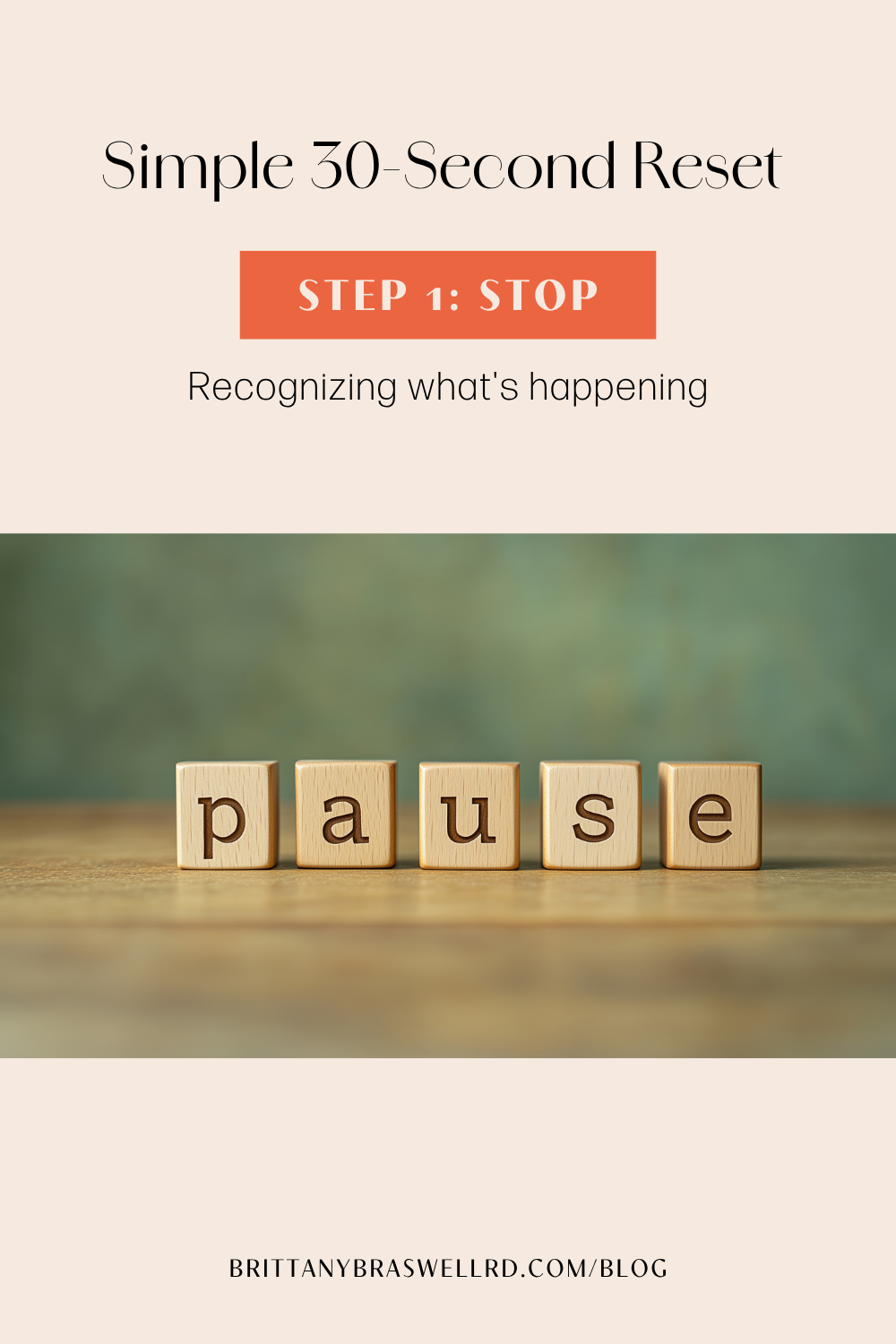
Step 1: Stop
The first step is simply recognizing what's happening.
Pause.
Acknowledge it.
You might say:
"My overwhelm is starting to talk right now."
That's it.
No judgment.
No fixing.
Just awareness.
Because you can't interrupt a spiral you don't recognize.
Step 2: Settle
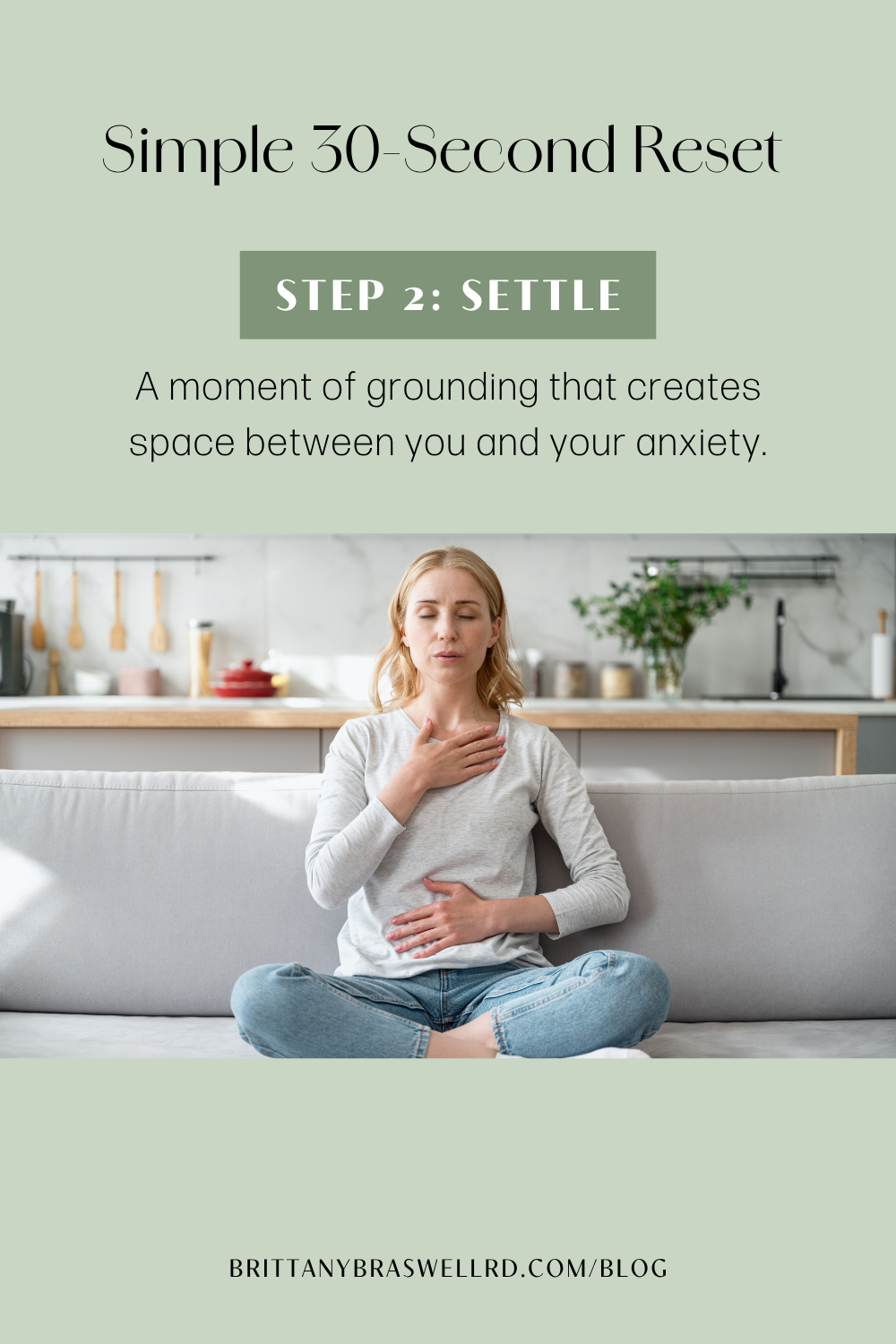
Next, settle into your body.
Place a hand over your heart.
Put a hand on your stomach.
Notice your breathing.
Then take a slow inhale and an even slower exhale.
Why?
Because longer exhales help communicate safety to your nervous system.
When your body begins shifting out of survival mode, your mind can begin slowing down too.
This tiny moment of grounding creates space between you and your anxiety.
And sometimes that space is exactly what you need.
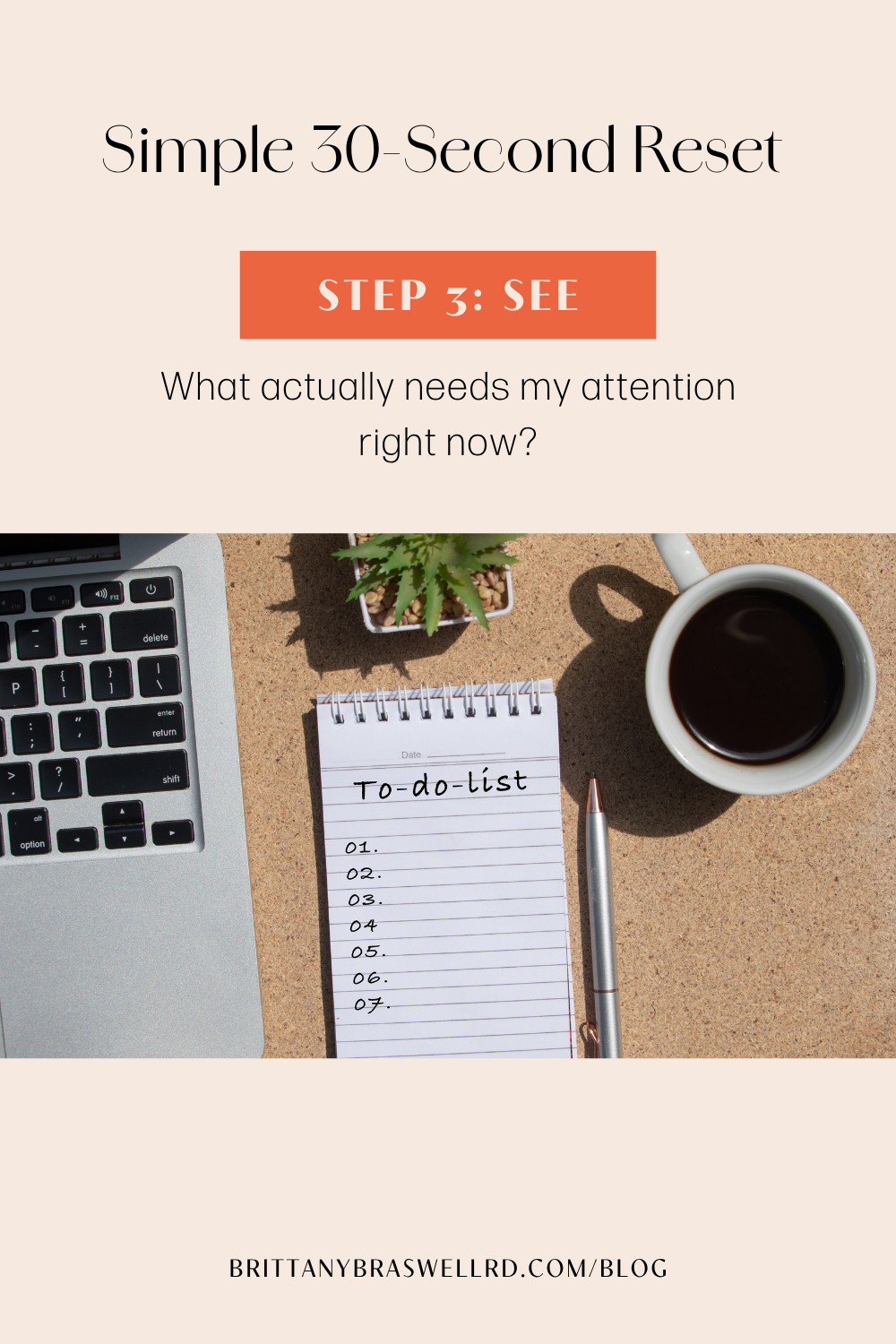
Step 3: See
Now ask yourself one simple grounding question:
What actually needs my attention right now?
Not tomorrow.
Not next week.
Not all 47 items on your mental to-do list.
Right now.
You can also ask:
- What can wait?
- What is most important in this moment?
- What would help me become more present?
This step helps pull you out of future-focused anxiety and back into reality.
Step 4: Step
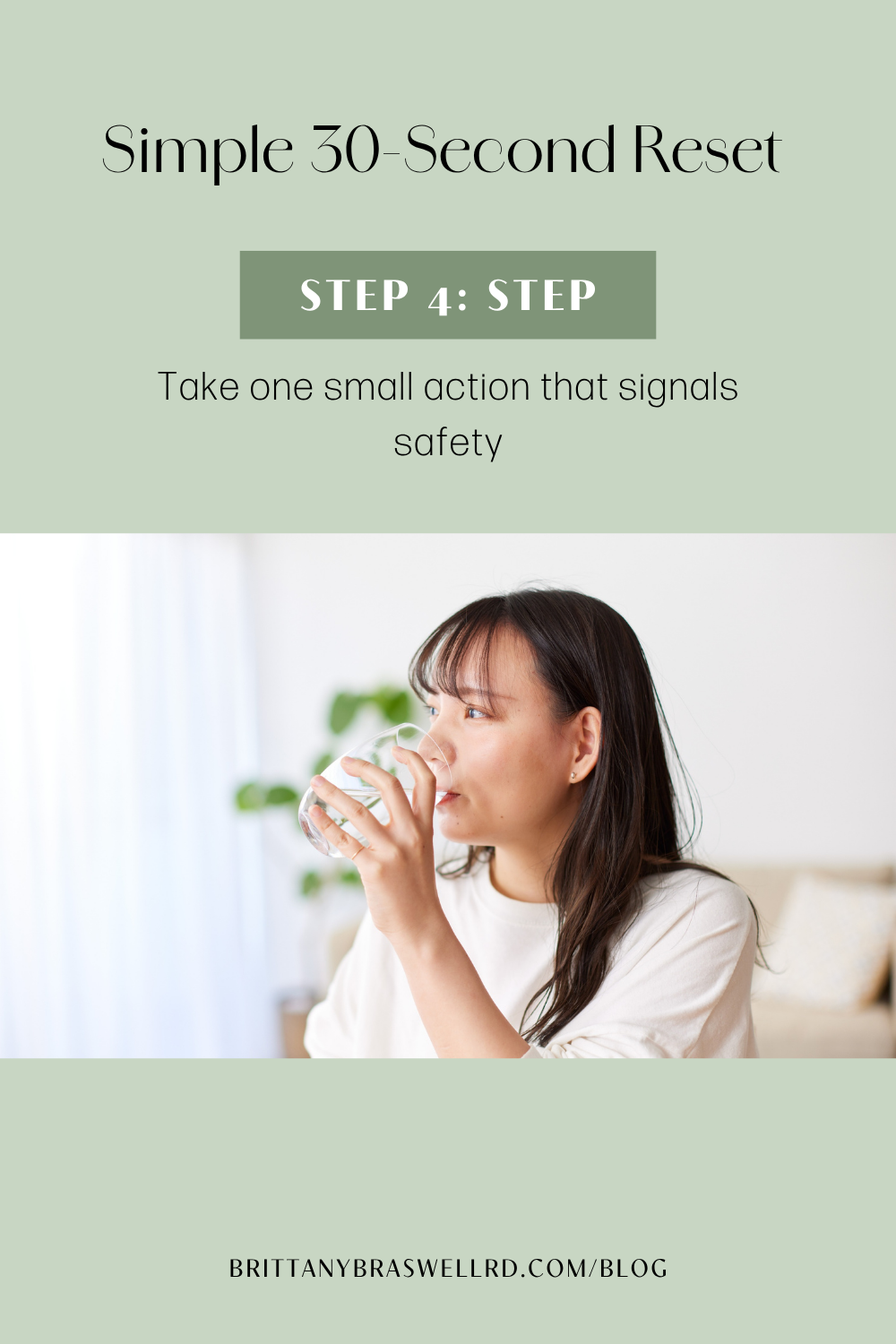
Finally, take one small action that signals safety.
Not ten actions.
Not an entire productivity overhaul.
One step.
Maybe that's:
- Drinking a glass of water
- Sitting down for two minutes
- Eating a balanced snack
- Taking a short walk
- Saying no to another commitment
- Taking a break from social media
For some of you, the bravest thing you'll do today is rest.
And friend, if the thought of sitting down for two minutes made you cringe a little, that might be your sign.
What Jesus Teaches Us About Overwhelm
One of my favorite reminders from this conversation is that slowing down is not laziness.
It's leadership.
We live in a culture that glorifies hustle.
A culture that tells women their worth is tied to productivity.
A culture that whispers:
"If you just worked harder..."
"If you were more disciplined..."
"If you could just get everything done..."
Then you'd finally feel at peace.
But that's not the example Jesus gave us.
When you read the Gospels, Jesus was never frantic.
Never rushed.
Never striving to prove His worth.
He consistently made space to pray.
To rest.
To withdraw.
To be present.
Even when there were still people who needed Him.
Even when there was more work to do.
Whaaaat?!
I know.
It's almost as if God knew we weren't designed to carry the weight of the world on our shoulders.
Because we're not.
Friend, your worth is not found in your productivity.
And it's not found in what you eat.
It's not found in the number on the scale.
It's not found in whether your Apple Watch rings are closed.
It's found in Christ.
Always has been.
Always will be.
How Nervous System Regulation Supports Food Freedom
One of the biggest misconceptions about food freedom is that it's only about changing what you eat.
But true food freedom is about so much more than food.
It's about learning to respond to your body with curiosity instead of criticism.
It's about recognizing when overwhelm is influencing your thoughts.
It's about understanding how your nervous system impacts your relationship with food.
And it's about creating enough space to hear God's voice above the noise of diet culture.
Because when your nervous system feels safe:
- Food feels less urgent.
- Cravings become less overwhelming.
- Body image struggles lose some of their power.
- Decision-making becomes easier.
- Peace becomes more accessible.
Not perfect peace.
But more peace.
And that's a beautiful place to start.
When Food Anxiety Feels Loud, Remember This
If food thoughts have felt especially loud lately, I want you to remember something.
Your overwhelm is not a character flaw.
Your anxiety is not proof that you're failing.
And the answer isn't more food rules.
The answer may simply be creating space to pause.
To breathe.
To settle.
To reconnect with what is actually happening beneath the surface.
Because sometimes what looks like a food struggle is really a signal that your heart, mind, and body need care.
And that care doesn't start with another food rule.
It starts with compassion.
Grab the Free 30-Second Reset Printable
If this framework resonated with you, make sure you're on my VIP email list.
I'm sharing a free printable version of this 30-second strategy so you can keep it nearby whenever overwhelm starts creeping in.
Continue Your Food Freedom Journey
If you're ready to cultivate a more peaceful, Christ-centered relationship with food and your body, here are a few ways to continue the conversation:
Listen to the Faith-Filled Food Freedom Podcast
Faith-Filled Food Freedom Podcast on Apple Podcasts
Join Our Free Community
Connect with other Christian women pursuing food freedom and body image healing.
Faith-Filled Food Freedom Community
Because friend, freedom isn't found in striving harder.
It's found in slowing down long enough to remember who you are, whose you are, and that Jesus has never asked you to carry the weight of perfection.
And that includes your to-do list, your body image, and your relationship with food.
Stay in touch by subscribing to my personal newsletter, The Full Plate Press
Join over 1000 others and get access to my weekly newsletter with a personal story, BTS sneak peaks, food freedom tips & strategies, riduculous memes, and BONUS goodies from me!
I'm Brittany!
Brittany Braswell, MS, RDN, LD
Host of Faith-Filled Food Freedom & Creator of The Intern Accelerator
I'm here to help Christian women around the world overcome negative body image and an anxiety-ridden relationship with food so they can finally stop stressing and obsessing over how they look and what they eat.