Stress Eating and the Christian Woman: What to Do Instead and How Food Freedom Heals
A while back, I worked with a woman who kept a bag of Doritos in her desk at work. It wasn’t there for snack time. It was there for survival. She worked at a university, managed a large team, and described her job as “high stress” so often that it could have been printed on her business card. When the day got loud, the drawer opened. The crunch gave her a few minutes of relief, and somehow she would end up at the bottom of the bag without being sure how she got there.
Here is what I want you to know about her: she was not weak, lazy, or short on faith. She was a capable, committed woman with exactly one tool in her coping toolbox, and it happened to be orange and triangle-shaped.
If you’ve ever reached for food when your day got heavy, you are in very good company. Stress eating is incredibly common, and it is often misunderstood in Christian circles, where it tends to get filed under “discipline problem” or “spiritual weakness.” It is neither one.
Stress eating has three layers: a physical layer (what stress does to your body), an emotional layer (what you’re feeling and what you need), and a spiritual layer (where you turn for comfort and peace). Most advice only addresses one of them. In this post, we’ll look at all three, and I’ll walk you through a grace-based, faith-rooted approach to finding peace beyond the plate.
What Is Stress Eating and Why Do We Do It?
Stress eating is turning to food for comfort, distraction, or relief from tension. It’s the handful of snacks while you answer emails, the second helping after a hard conversation, or the sweet treat you “earned” after a long day with the kids.
It is also a coping mechanism, not a character flaw. A coping mechanism is simply something your brain learned to use to get through a hard moment, and food works quickly, which is exactly why it sticks.
Your body plays a role here too. When you’re under stress, it releases hormones like cortisol, which can increase appetite and make high-sugar, high-fat foods feel especially appealing. Stress also leaves you tired, and a tired body is often looking for a quick source of energy. So when you find yourself craving crunchy, salty, or sweet foods on a hard day, your body is not betraying you. It is doing what bodies do under pressure.
Take a minute to reflect on your own patterns:
- What time of day do you most often reach for food when you aren’t hungry?
- What kinds of situations tend to set it off: work deadlines, parenting, family tension, loneliness?
- What are you usually feeling in the moments right before?
Awareness isn’t about shame. It’s about gathering information.
The Myth: “If I Had More Faith, I Wouldn’t Emotionally Eat”
Let’s address the elephant in the sanctuary. Many of the women I work with have quietly believed that if they just prayed harder, read more, or trusted God more, the emotional eating would disappear.
That belief is not true, and it is quietly doing damage. Stress eating is not simply a spiritual failure or a lack of discipline. If it were, the most devoted women in your church would be immune, and they aren’t.
God created you with emotions. Jesus wept. Jesus was “sorrowful and troubled” in Gethsemane. Emotions are not a malfunction in your faith. They are part of how you were made. And food is not the enemy either. It is a gift, and eating in an emotional moment does not make you a bad Christian.
The real question is the difference between a human need and a heart issue. Needing comfort, rest, or safety is human. Using food as your only way to meet those needs is a pattern worth gently examining, but it’s one to examine with compassion, not condemnation. Psalm 103:14 reminds us of how God sees us:
“For he knows our frame; he remembers that we are dust.” (Psalm 103:14, ESV)
He is not surprised by your humanity. Healing comes through connection, not condemnation.
How Suppressing Emotions Fuels the Cycle
Many of us were taught, kindly and with good intentions, to “pray it away.” Feel anxious? Pray. Feel overwhelmed? Pray. Feel angry or sad? Pray, smile, and bring a casserole.
Prayer is powerful and we need it. But praying instead of acknowledging what you feel is a different thing. When stress gets stuffed down instead of processed, it doesn’t disappear. It goes underground, and unaddressed stress becomes hidden coping mechanisms.
This is where food slips in. It can become a stand-in for rest when you’re exhausted, for safety when you feel out of control, and for comfort when no one seems to notice how heavy things are. The snack isn’t really about the snack.
The first step toward change is <u>honest emotional awareness</u>. Before you can bring something to God, you have to be willing to name it. “I’m overwhelmed” is a complete and holy sentence.
The Common Mistake: Using Food as the Only Form of Relief
There’s nothing wrong with food being one source of comfort. Warm soup on a cold day does a soul good. The trouble starts when food is the only form of relief you have.
Food is often used to soothe instead of support. Soothing quiets the feeling for a moment. Support actually meets the need underneath it. A bowl of ice cream can soothe a hard day, but it cannot call a friend, set a boundary, or ask for help.
It also helps to understand the difference between eating for satisfaction and eating to escape. One leaves you feeling nourished and present. The other leaves you feeling numb, or a little ashamed, and no closer to what you needed.
Reaching for food automatically can quietly delay true emotional healing, because the need keeps going unmet. So here’s a gentle invitation: this week, simply notice when you’re seeking comfort in the wrong place. No fixing yet, just noticing.
5 Christ-Centered Alternatives to Stress Eating
Once you’ve noticed the pattern, you need somewhere else to go. Here are five alternatives that meet the whole woman, body and soul:
- Pause and pray. Bring the emotion to God before you react. Even sixty honest seconds counts.
- Journal what you’re feeling and what you truly need. Writing it out helps you separate “I’m hungry” from “I’m drowning.”
- Move your body in a gentle way. A short walk can help release built-up tension without turning into punishment.
- Practice breathwork or grounding with Scripture or worship. Slow breathing paired with a verse or a worship song calms your body and anchors your mind.
- Reach out to a trusted friend, mentor, or counselor. You were never meant to carry stress alone.
Philippians 4:6-7 ties this together:
“do not be anxious about anything, but in everything by prayer and supplication with thanksgiving let your requests be made known to God. And the peace of God, which surpasses all understanding, will guard your hearts and your minds in Christ Jesus.” (Philippians 4:6-7, ESV)
A quick word of care: if your eating feels out of your control, or you are working through a diagnosed eating disorder, please lean on your treatment team alongside these tools. They support professional care. They don’t replace it.
How Food Freedom Supports Emotional and Spiritual Healing
Alternatives help in the moment. But if you want lasting change, the foundation matters, and that is where food freedom comes in.
When you remove rigid food rules, you also remove much of the guilt and fear-based eating that fuels the stress cycle. Restriction and stress eating are close cousins, and the more you tell yourself a food is off-limits, the more power it has when you’re worn down.
Food freedom also helps you build the skill of telling emotional hunger from physical hunger. Intuitive eating gives you a way to ask, “What do I actually need right now?” instead of running on autopilot. As you rebuild body trust, impulsive patterns tend to quiet down, because you’re no longer at war with yourself.
Most importantly, it lines up with a life of grace, not perfectionism. You aren’t trying to eat flawlessly. You’re learning to live free.
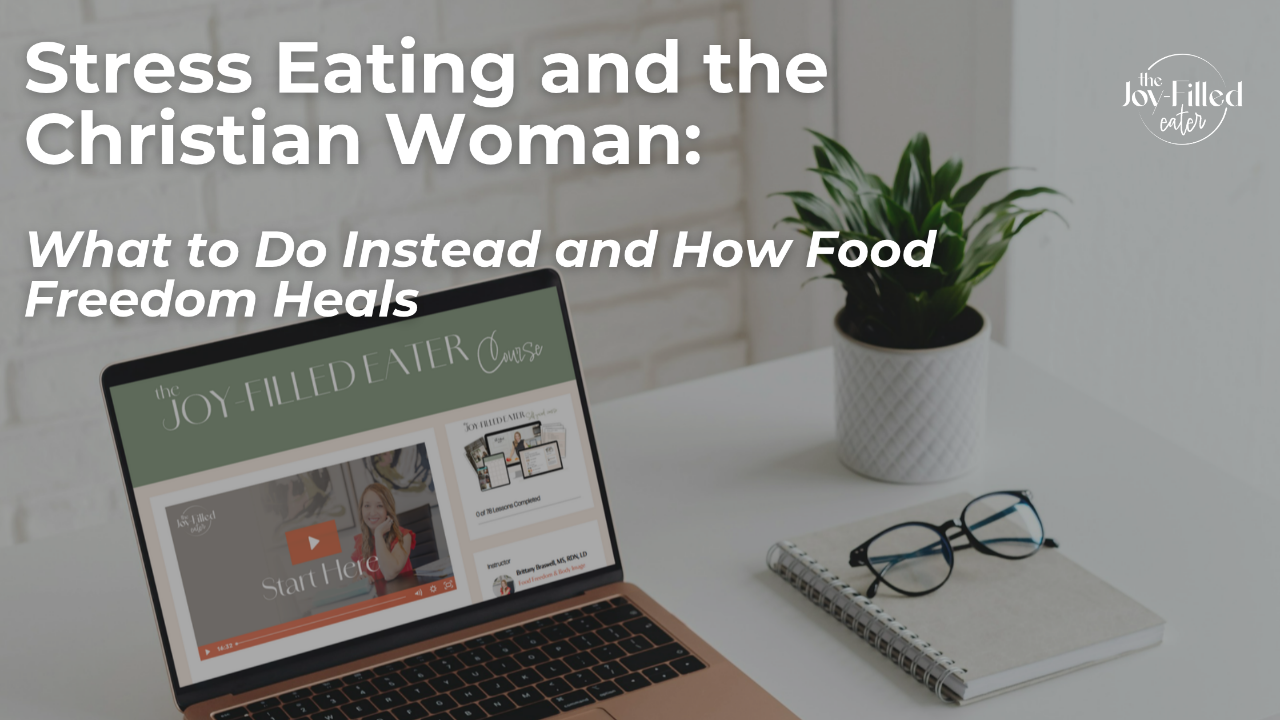
This is the heart of what we do inside The Joy-Filled Eater Course, a self-paced, Christ-centered approach to food freedom and body image for women who are ready to stop white-knuckling and start healing. If that sounds like where you are, start here: The Joy-Filled Eater Course.
Frequently Asked Questions
Is it ever okay to eat for comfort?
Yes. Food is allowed to be comforting, and your grandmother’s soup recipe is proof. Comfort eating becomes a concern only when it’s your only source of comfort, or when it’s followed by guilt. Occasional comfort is part of being human.
What if I don’t realize I’m stress eating until afterward?
That is a very normal place to start. Awareness usually comes in stages, first after the fact, then during, and eventually before. Each time you notice, even late, you are building the skill. Meet yourself with curiosity, not criticism.
How can I break this habit when life feels overwhelming?
Start smaller than you think you need to. You don’t have to overhaul your life or your eating this week. Pick one of the five alternatives above and try it once. Small, kind, repeated steps beat dramatic, short-lived ones.
What if food feels like the only comfort I have right now?
First, there’s no shame in that. It simply tells us how much you’ve been carrying. The goal isn’t to take food away. It’s to give you more places to turn. If you feel stuck here, you deserve real support, and that is exactly what a guided, faith-centered approach can offer.
Final Thoughts: Let God Be Your Peace, Not Just Food
Food can give you a few minutes of relief, but God offers a peace and satisfaction that don’t run out when the bag is empty. Healing happens as you pursue emotional honesty and a deeper intimacy with Him, bringing Him the real, unedited version of your day.
In Matthew 11:28-30, Jesus says:
“Come to me, all who labor and are heavy laden, and I will give you rest. Take my yoke upon you, and learn from me, for I am gentle and lowly in heart, and you will find rest for your souls. For my yoke is easy, and my burden is light.” (Matthew 11:28-30, ESV)
And 1 Peter 5:7 invites us to do the same:
“casting all your anxieties on him, because he cares for you.” (1 Peter 5:7, ESV)
You were never meant to white-knuckle your way through stress, and you were never meant to numb it either. You were invited to bring it to Him.
If you’re ready to overcome stress eating and build lasting food freedom and a healthier relationship with your body, take your next step here: The Joy-Filled Eater Course. Everything you need to know is on that page.
And if you’d like more encouragement between now and then, come listen to the Faith-Filled Food Freedom podcast for weekly conversations on healing your relationship with food and your body.
Stay in touch by subscribing to my personal newsletter, The Full Plate Press
Join over 1000 others and get access to my weekly newsletter with a personal story, BTS sneak peaks, food freedom tips & strategies, riduculous memes, and BONUS goodies from me!
I'm Brittany!

Brittany Braswell, MS, RDN, LD
Host of Faith-Filled Food Freedom & Creator of The Intern Accelerator
I'm here to help Christian women around the world overcome negative body image and an anxiety-ridden relationship with food so they can finally stop stressing and obsessing over how they look and what they eat.